Tracks
  Future of SportsTech Report
  Executive Summit
  Official Hotel
  2026 Speakers
  2026 Photos
  Who Attended
  FAQs
FAQs Youth Sports Technology in 2027: Inside a $40B Market
 Peak Conference
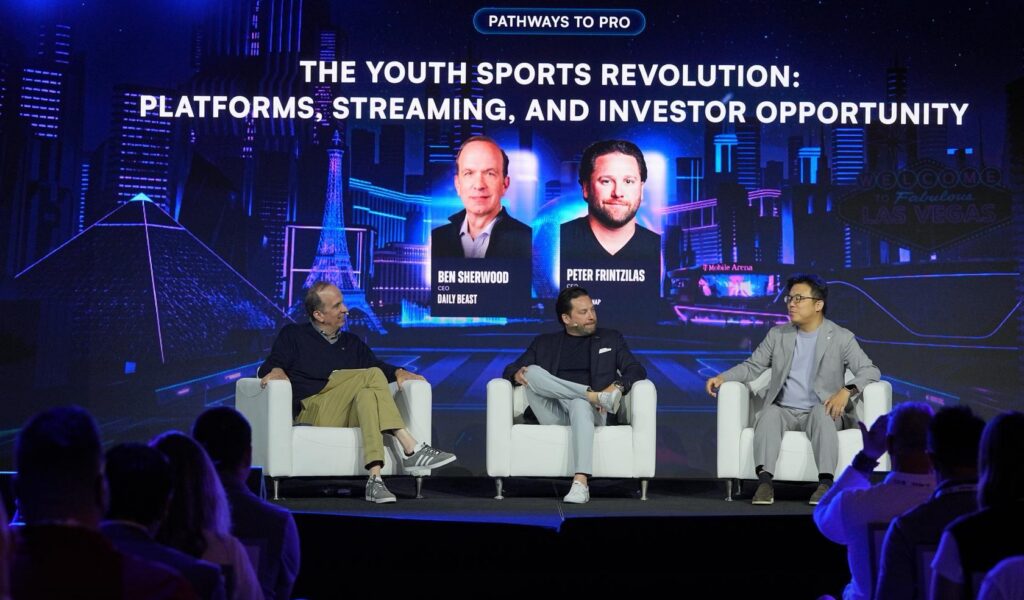
Youth sports to the NFL. That was the comparison on the PEAK main stage, and it wasn’t hyperbole. What was once treated as a grassroots category has become a fast-scaling $40 billion economy, with youth sports technology increasingly powering how leagues operate, monetize, stream games, and reach families.
Here’s the number that gets people’s attention: $40 billion. That’s the size of the U.S. youth sports economy today (the full universe of registration fees, training, equipment, apparel, and travel that families spend on organized sports), according to Pete Frintzilas, CEO of TeamSnap, the platform sitting at the center of the technology layer built on top of that economy.
“When you’re in it, you don’t think of this as a massive industrial complex,” Frintzilas said. “I’m a volunteer coach. I’m the Uber driver. I’m the equipment organizer. You’re not thinking about the size of the market. But when you start to think about programming fees, registration, training, equipment, apparel, travel, all the cost associated with the enterprise of sports tourism, it becomes a $40 billion market very quickly. And we believe it’s growing at an even faster rate than most believe today.”
What is youth sports technology?
Youth sports technology is the software and hardware layer built on top of that $40 billion economy, distinct from the economy itself and from professional or collegiate sportstech. It spans four core layers:
- Operations and registration: scheduling, rosters, communication, payments (TeamSnap, SportsEngine, Bound)
- Sponsorship and monetization: connecting brands with local clubs and leagues (LeagueSide, now part of TeamSnap)
- Streaming and content capture: AI cameras and highlight generation for games that would otherwise go unrecorded (XbotGo, Pixellot, GameChanger)
- Athlete data and development: performance tracking and benchmarking as kids move through a sport
TeamSnap is the category’s clearest reference point for scale: more than 19,000 sports organizations, 30 million users, and over 100 different sports run through its platform.
The numbers behind the youth sports technology boom
$40B
U.S. youth sports economy
19,000+
Sports organizations on TeamSnap
30M
TeamSnap users
$20M+
Brand sponsorship invested via LeagueSide/TeamSnap
As recently as 2022, TeamSnap’s own materials cited Wintergreen Research’s estimate that the U.S. youth sports market was worth $19.2 billion. Whether you anchor to that figure or the $40 billion Frintzilas cites today, the trajectory is the same: this is one of the fastest-appreciating estimates of any consumer spending category in the country, and technology providers are racing to capture a piece of it.
Where youth sports technology is growing fastest
The category breaks down into four commercial layers, each moving at a different speed:
Operations and payments. Scheduling, registration, communication and club management remain the category’s most mature layer, and the one with the most consolidation, as platforms like TeamSnap absorb adjacent functions rather than compete purely on features. That consolidation is active elsewhere too: in 2025, Genstar Capital backed the merger of PlayMetrics and Stack Sports into a single sports-management software platform, an explicit roll-up of registration, league-management, and club-services tools that used to be separate products.
AI streaming and content. Automated cameras like XbotGo’s Falcon and Pixellot’s systems are solving a problem that’s existed for decades: the vast majority of youth games have never been recorded at all. This is currently the fastest-growing layer by investment and partnership activity, and it’s also drawn some of the category’s largest recent price tags: GTCR’s youth sports arm, Ascent Sports Group, acquired the livestreaming platform LiveBarn in a deal reported at $400 million.
Sponsorship marketplaces. Platforms like LeagueSide (now part of TeamSnap) solve a matching problem: connecting national and regional brands with thousands of fragmented local clubs and leagues that would be nearly impossible for a brand to reach individually.
Athlete development and data. Still the earliest and thinnest layer specific to youth sports. Most performance-tracking technology has so far been built for professional and collegiate athletes, and is only beginning to move downstream into youth programs.
Case study: how TeamSnap built a platform, not just an app
TeamSnap’s last five years are a useful blueprint for how a category leader in youth sports actually gets defensible, layer by layer.
Step one: own the operating system. TeamSnap started as the scheduling and communication tool clubs and leagues run on: the unglamorous back-office layer every organization needs and few want to build themselves.
Step two: own the money. In November 2022, TeamSnap acquired LeagueSide, at the time America’s leading community sports sponsorship platform. The acquisition gave TeamSnap’s network of 19,000+ organizations direct access to brand sponsorship dollars, and brands have since invested more than $20 million in youth sports sponsorships through the platform, funding that flows back into the clubs and leagues themselves (independently confirmed by SportsTravel).
Step three: own the memory. In April 2026, TeamSnap announced an exclusive partnership with XbotGo, maker of the Falcon AI-powered sports camera, integrating live streaming, robotic camera tracking, and automatic highlight capture directly into the TeamSnap ONE app. The integration went live to all TeamSnap ONE users that August.
“As a sports parent myself, I know the struggle of missing a goal while fiddling with a phone,” said David Tan, XbotGo’s founder and CEO. “XbotGo was built to make sports video smarter, simpler, and more accessible.”
Three layers, three different revenue opportunities: operations, sponsorship, and content, all sitting on top of the same household relationship.
The investment case: why youth sports is considered recession-resistant
The pitch every investor has heard by now is that youth sports is recession-proof. Frintzilas doesn’t disagree with the underlying data, but he thinks most people drawing that conclusion are underwriting the category wrong.
“This is as recession-proof of a category as you’re going to get,” he said. “All the data, all the analysis we’ve done, states that in a time of recession, youth sports is one of the last things to go. And COVID, if anything, showed the strength of this market. Out of COVID, the tailwinds have only accelerated. It proved that kids need to be on the field, on the courts, on the rink, mental health, fitness, health. But it’s also accelerated the industrialization, and really the professionalization, of what is now becoming this industrial complex of youth sports.”
That last part is the catch. Resilient consumer spending has pulled private equity and family offices into youth sports at a pace the category hasn’t seen before, and Frintzilas is candid that most of the resulting bets will fail.
That pace shows up clearly in recent deal activity. Beyond the Stack Sports and LiveBarn deals mentioned above, Unrivaled Sports, which aggregates youth tournament operators and facilities including Ripken Baseball and Cooperstown All-Star Village, raised $120 million in growth equity led by DICK’S Sporting Goods in 2025, valuing the company at more than $650 million. According to L.E.K. Consulting, more than $2.5 billion flowed into new or upgraded youth sports complexes between 2024 and 2026 alone.
“If you’re coming in to underwrite this category as a traditional vertical SaaS embedded-payments company, you’re likely wrong,” he said. “There’s probably a few of us that can get to the scale to make the unit economics work, to make the margins work. Outside of that, it becomes a cash-burn category, and there are hundreds of companies right now going through that.”
The real moat, in his view, isn’t the software at all. “The real power becomes the distribution. The real defensible moat is the trust you’re able to build with millions upon millions of households.” Scale the math out: bring on one club of a thousand kids, and at roughly a parent and a half per kid, that’s 1,500 households a platform can now bring new services to, if it’s earned the right to.
That pace of consolidation hasn’t gone unnoticed in Washington. A bicameral bill called the Let Kids Play Act, introduced in Congress in May 2026, would designate any private equity fund invested in youth sports as a “vulture investor” unless the firm certifies compliance with a new set of conduct rules, triggering a two-year divestment clock and escalating financial penalties for firms that miss it. The bill hasn’t passed and its prospects remain uncertain, but its introduction signals that the same industrialization Frintzilas describes as inevitable is now drawing direct legislative attention, another reason underwriting this category like an ordinary software business misses the real risk profile.
Common mistakes to avoid
- Treating it as a SaaS category, not a trust category. Software that helps a club run its season is table stakes. The defensible asset is the household relationship built on top of it.
- Chasing hardware without distribution. A great camera or app with no existing base of trusted organizations to sell into is a much harder path than partnering into one that already exists.
- Underestimating the back-office burden. Local club owners and volunteer coaches don’t want more dashboards; they want workflows fully automated so they can focus on the kids.
- Underestimating the parent as the economic decision-maker. For many youth sports products, parents ultimately control the household spend, which makes their trust critical even when a club, league, or sponsor is the direct customer.
- Assuming this is a normal cash-flow business from day one. Frintzilas is direct that most companies underwriting the category as a standard vertical SaaS play will burn cash before they find the unit economics that work.
Frequently asked questions about youth sports technology
How big is the youth sports market?
The U.S. youth sports economy is roughly $40 billion, according to TeamSnap CEO Pete Frintzilas, including spending on registration, training, equipment, apparel, travel, and other costs associated with organized youth sports. That figure describes the broader economy, not the technology layer specifically. For context, TeamSnap’s own materials cited a $19.2 billion U.S. estimate from Wintergreen Research as recently as 2022, a sign of how quickly the market’s perceived size has grown.
Why is youth sports considered recession-resistant?
TeamSnap CEO Pete Frintzilas argues that youth sports spending has proven unusually resilient during downturns, ranking behind essentials like housing, transportation, and food when families cut back, and that momentum in the category accelerated after COVID-19 rather than slowing.
What companies are leading youth sports technology?
TeamSnap is one of the category’s largest platforms, with 19,000+ organizations and 30 million users across 100+ sports. It has expanded through acquisitions like LeagueSide (sponsorship) and partnerships like XbotGo (AI streaming cameras). Other notable players include GameChanger (a DICK’S Sporting Goods company) and Pixellot in the streaming and content layer.
How is private equity changing youth sports?
Private equity and family offices have moved into youth sports specifically because of its resilient spending pattern. But industry leaders caution that most new entrants underwriting the category as standard vertical SaaS businesses will struggle to reach the scale needed for the unit economics to work: the category rewards distribution and household trust over software alone.
Is there pushback against private equity’s role in youth sports?
Yes. A bicameral bill known as the Let Kids Play Act, introduced in Congress in May 2026, would require private equity funds invested in youth sports to certify compliance with new conduct rules or face mandatory divestment and financial penalties. It has not become law, but its introduction reflects growing political scrutiny of the same consolidation trend that’s driving current investment in the category.
What is the youth sports streaming market?
Youth sports streaming and content capture (driven by AI cameras that automatically track games and generate highlights) is one of the fastest-growing layers of the category, addressing the fact that the vast majority of youth games have historically gone unrecorded entirely.
Why this is a Business of SportsTech conversation
Youth sports sits at the intersection of two things PEAK has tracked closely: the professionalization of sport as an asset class, and the platforms being built to run it. The same forces reshaping fan engagement and revenue diversification at the professional level, data, streaming, sponsorship marketplaces, are now playing out at the grassroots level, just with a different customer: the parent, not the season-ticket holder.
For the fuller data picture across the industry, see PEAK’s SportsTech Report.
Discounted tickets on sale now
Join the conversations shaping the next $40 billion of sportstech, live.
Discounted tickets are on sale now, and Sports Organization passes are 100% funded by application. March 31–April 2, 2027 · Fontainebleau, Las Vegas.
Related reading: Fan Engagement in 2027 | Sports Revenue Streams in 2027 | The Future of Sports Technology
Back to top ↑
subscribe to the Peak insider newsletter
Get exclusive insights and connect with top investors in the industry.