Speakers
  Tracks
  Future of SportsTech Report
  Executive Summit
  Startup World Cup 2027
  Official Hotel
  2026 Photos
  Who Attended
  FAQs
FAQs The 5% Problem: What Las Vegas Actually Tells Us About the Sports Economy
 Peak Conference
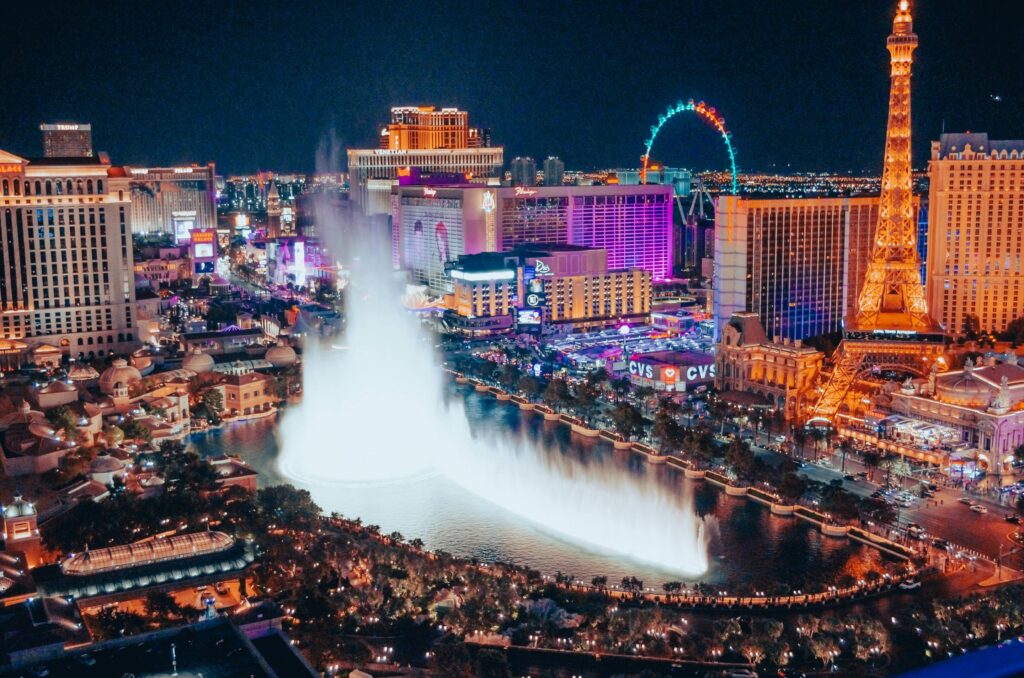
Las Vegas has the Raiders, the Golden Knights, the Aces, Formula 1, UFC and a Super Bowl on the way back. In 2025, five percent of its visitors went to a game. That number is not a failure. It is the clearest statement of the opportunity anyone in this industry has been handed.
The Las Vegas sports economy at a glance
| Indicator | Figure | Source |
|---|---|---|
| Annual visitor volume | 38.5 million in 2025, down 7.5% year on year, against a record 42.9 million in 2016 | LVCVA, 2025 |
| Major professional teams | Three resident: Raiders (NFL), Golden Knights (NHL), Aces (WNBA). The Athletics (MLB) arrive in 2028, with an NBA franchise under evaluation | Club and league announcements |
| Sports tourism impact | 1.8 million visitors attended a sporting event, spending $3.6 billion, for an estimated $5.7 billion impact and 16,400 direct jobs | LVCVA, 2024 estimate |
| Share of visitors attending sport | 5% attended a sporting event, 13% viewed one, and roughly 3% named sport as their main reason for visiting | LVCVA Visitor Profile Study, 2025 |
| Major events hosted or confirmed | Super Bowl LVIII (2024), F1 Las Vegas Grand Prix (annual), NBA Summer League, UFC International Fight Week, CFP National Championship (2027), NCAA Men’s Final Four (2028), Super Bowl LXIII (2029) | Event organisers |
| Wider economic contribution | $50.8 billion in direct visitor spending and $80.9 billion in total impact, supporting roughly one in three Southern Nevada jobs. Strip resort revenue was $21.1 billion in fiscal 2025 | Applied Analysis for LVCVA; Nevada Gaming Control Board |
The number almost everyone got wrong
When the Las Vegas Convention and Visitors Authority published its 2025 Visitor Profile Study in March 2026, a lot of trade coverage reported that 13% of visitors attended a sporting event, up from 10% the year before.
That is not what the study says.
The LVCVA asks two separate questions. One asks whether a visitor attended a sporting event. The other asks whether they viewed one, which captures watching in a sportsbook, a bar or a hotel room. The answers are different numbers:
- 5% attended a sporting event in 2025 (up from 4% in 2024, but below the 6% recorded in both 2022 and 2023).
- 13% viewed a sporting event in 2025 (up from 10% in 2024).
Roughly 3% said attending a sporting event was the primary purpose of their trip at all.
The distinction matters commercially. Viewing is a hospitality and betting behaviour. Attending is a ticketed, in-venue, data-generating relationship. Las Vegas welcomed 38.5 million visitors in 2025. On the attendance figure, the in-venue sports market is somewhere near two million trips before a single local resident is counted. On the viewing figure, it looks almost three times larger. Any operator building a business case off the wrong one is building it off sand.
Sports visitors are not the customer you think they are
The study’s Sports Visitors spotlight compares visitors who attended a sporting event with those who did not. The base is small, so treat the exact dollars as directional rather than precise. The pattern, however, is consistent and it is the opposite of the Las Vegas cliché.
- Sports visitors stayed an average of 3.5 nights, against 3.2 for everyone else.
- They travelled in larger parties, averaging 2.6 adults against 2.3.
- They spent $201.08 per night on accommodation, against $173.03.
- They spent $759.90 on food and drink across the trip, against $572.93.
Then the part that should reframe how teams talk to hospitality partners. Sports visitors gambled less. Their average gambling budget was $635.02, roughly $50 below non-sports visitors. The LVCVA’s own summary describes sports visitors as spending more across most categories, staying longer, and being more likely to return in a short timeframe.
So the sports customer in Las Vegas is a longer-staying, larger-party, higher-spending, more loyal visitor who is less interested in the casino floor than the average tourist. That is not a rounding error in the Las Vegas model. It is a different customer entirely, and one the city has barely started to convert at scale.
The number that moved most
Buried in the expenditure tables is the most interesting single data point in the study. Average per-trip spending on sporting events across all Las Vegas visitors, including the 95% who did not attend anything:
- 2024: $12.27
- 2025: $22.30
That is an increase of roughly 82% in a single year, in a year when total visitation fell 7.5% and per-trip spending on food and drink, shopping and sightseeing all declined. Among visitors who spent anything on sporting events at all, the average rose from $357.06 to $452.48.
Fewer people came to Las Vegas in 2025. The ones who came spent meaningfully more on sport. That is the signal.
Why the Strip needs this more than it is letting on
The commercial context makes the sports opportunity urgent rather than merely interesting.
The Nevada Gaming Control Board’s 2025 Gaming Abstract, released in June 2026, covers the 51 Las Vegas Strip casinos reporting $1 million or more in annual gaming revenue. Two findings from it deserve to be read together.
First, the Strip is not a gambling business. Gaming accounted for 26.1% of total Strip revenue. Rooms were the single largest category at roughly 33.5%, generating $7.1 billion, with food at $3.99 billion, beverage at $1.58 billion and other departments at $2.9 billion. It was the 27th consecutive year in which gaming made up less than half of Nevada resort revenue.
Second, and less widely discussed, the Strip’s profitability collapsed. Total Strip revenue of $21.1 billion was the second highest figure ever recorded. Net income before federal income tax and extraordinary items was $154.2 million, down roughly 81% year on year, a decline of about $666 million. Revenue fell 3.7%. General and administrative expenses rose 0.4%. That gap is the entire story.
Put those two findings against the visitor data and the strategic picture is unambiguous. Almost three quarters of Strip revenue now comes from rooms, food, beverage and experiences. The sports visitor over-indexes on exactly those categories and under-indexes on the one that is shrinking as a share of the business. And the operating model has almost no margin left to absorb another soft year.
Las Vegas does not need sport because it is glamorous. It needs sport because sport brings the specific customer its profit and loss statement is now built around.
The calendar is the product
Las Vegas has 150,300 hotel rooms, the largest inventory in the United States. In 2025 it ran 80.3% annual occupancy against a US average of 62.3%, with an average daily rate of $183.52 and RevPAR of $147.30, down 8.8% on the year. Strip properties specifically ran 89.1% occupancy at an average daily rate of $250.72.
Filling rooms is not the problem. Filling them evenly is. Which is why the shape of the sports calendar matters as much as its size.
The physical infrastructure is already in place, and it is unusually concentrated. Allegiant Stadium sits a short walk from the south end of the Las Vegas Strip and handles the NFL, college football and the largest one-off events. T-Mobile Arena, opened in 2016 by AEG and MGM Resorts before the Golden Knights had played a game, carries NHL, UFC, boxing and the arena calendar, and is now central to the NBA expansion conversation. Harry Reid International Airport delivers visitors within minutes of both. The Las Vegas Convention Center, which hosted around six million convention delegates across the city’s 2025 calendar, adds the conference and trade infrastructure that lets a game weekend absorb sponsor activations, media functions and corporate hospitality without anyone building anything new.
Most cities have to construct an entertainment district around a stadium to make the economics work. In Las Vegas the district already existed, and the venues were dropped into it.
The next four years are unusually dense:
- January 25, 2027: College Football Playoff National Championship, Allegiant Stadium
- 2028: the Athletics are scheduled to open their Strip ballpark, adding 81 home dates a season
- April 1 and 3, 2028: NCAA Men’s Final Four, Allegiant Stadium
- 2029: Super Bowl LXIII, Allegiant Stadium, awarded in March 2026
The Athletics are the genuinely new variable. A Super Bowl is a single enormous weekend. Eighty-one home dates is inventory spread across spring, summer and early autumn, including ordinary weeknights. A Tuesday in June against an unglamorous opponent will never sell like a Raiders Sunday. But from the destination’s point of view, that is precisely what makes it valuable: it puts sports inventory into the parts of the week that are hardest to fill.
It also makes the Athletics the hardest commercial problem in American sport right now. Converting a transient, high-intent, once-a-year visitor into a ticket buyer is one job. Doing it eighty-one times a year, alongside a local season ticket base you have to build from nothing, is a different one. Every ticketing, CRM, pricing and fan data vendor in this industry should be watching how it is solved, and it is exactly the kind of problem our Solution Huddles are built to put in front of the people solving it.
The real constraint is not fans. It is the corporate wallet
The optimistic case for Las Vegas sport writes itself. The constraint is less obvious and it is not attendance.
The Raiders, Golden Knights, Aces, Formula 1 and UFC already sell sponsorship, suites and premium hospitality into a shared pool of local and national companies. The Athletics will enter that market in 2028. And in March 2026 the NBA Board of Governors voted unanimously to formally explore expansion into Las Vegas and Seattle, engaging PJT Partners as strategic adviser, with expansion fees reported in the $7 billion to $10 billion range and a target of the 2028-29 season.
That process is live right now. Bill Foley’s group was first to file formally, with a reported $300 million to $400 million committed to upgrading T-Mobile Arena. In July 2026 the Las Vegas Jacks group, fronted by Jerry Colangelo, announced $8 billion in financial commitments. Commissioner Adam Silver told media at Summer League in July that multiple serious groups were presenting plans, and that he hopes for a decision by the end of 2026.
So Las Vegas may soon be asking its corporate base to support seven major sports properties simultaneously. Each one needs naming rights, category sponsors, suite holders and year-round client entertainment budgets. MGM, Caesars, banks, airlines, automotive brands and technology firms can support several. They cannot support all of them at the level each property will need without some of that money simply moving between properties.
This is the question the industry should be arguing about, and it is not a Las Vegas question. It is the same question facing every market adding inventory faster than it is adding demand. How much genuinely new commercial spending does each additional property create, and how much of it is displacement wearing a different logo? Our Future of USA SportsTech Report maps where that commercial spending is currently concentrated.
Why the Las Vegas sports economy matters
Strip the local detail away and the Las Vegas data becomes a working model for any market adding sports inventory faster than it is adding demand. What it means depends on which side of the table you sit on.
For founders
Las Vegas is the most concentrated live testbed in the industry. Three resident leagues, a self-promoted Formula 1 race, a UFC headquarters and a visitor base that turns over every 3.2 nights sit inside a few square miles. That combination lets you validate a product against transient and resident audiences at the same time, which almost nowhere else offers.
The commercial lesson is sharper than the geography, though. The 5% and the 13% are two different products. Attending is ticketing, access control, CRM and premium hospitality. Viewing is content, betting, second-screen and venue-adjacent experience. Most founders build for one and pitch as though they serve both. Pick the one your data actually addresses and size it honestly. Our breakdown of how the sportstech funding landscape has shifted covers where that discipline is now being rewarded.
For investors
The Las Vegas premium is being priced in ahead of the evidence. NBA expansion fees are reported in the $7 billion to $10 billion range for a market that ranks around 40th by television households. Bill Foley’s group entered the NHL at $500 million in 2016, when the market was unproven. Everyone arriving now is buying a validated thesis at a validated price.
The more useful question is not what a franchise earns on its own but how much of the surrounding spending an owner actually captures. In Las Vegas the ticket, the hotel room, the meal, the ride and the casino visit frequently belong to different balance sheets. Ownership structure determines who gets paid, and it varies enormously from venue to venue.
For teams and venues
The Las Vegas sports visitor stays longer, travels in a larger party, spends more on accommodation and food, and gambles less than the average tourist. Value shows up across the whole trip, not at the point of sale. If your attribution stops at the turnstile, you are systematically undercounting your own audience and underselling it to partners.
The second lesson is about calendar shape. The strategic value of an event is not its peak attendance but what it does to the weeks around it. Eighty-one ordinary Athletics dates may be worth more to the destination than one spectacular Super Bowl weekend, because they land where demand is weakest. That reframes what a “good” fixture actually is.
For sponsors and brands
Commercial saturation arrives before fan saturation. Fans will absorb more sport. Sponsorship and hospitality budgets will not, at least not at the same rate. With six major properties competing today and potentially seven by 2028, buyers in this market are about to gain real leverage, and sellers will need to prove incremental reach rather than assert it.
The counterweight is audience quality. A customer who spends $201.08 a night on a room and $759.90 on food and drink across a trip is a different proposition to a category partner than a headline attendance figure. Sponsors who evaluate on trip value rather than gate value will find the Las Vegas inventory considerably more attractive than it looks on paper.
For technology companies
Almost three quarters of Las Vegas Strip revenue now comes from rooms, food, beverage and experiences rather than gaming, and Strip profitability fell roughly 81% in fiscal 2025 despite near-record revenue. That combination creates genuine urgency around anything that lifts conversion, yield, dwell time or repeat visitation.
The practical opportunities cluster around three problems: converting a once-a-year visitor into an identified, contactable fan; pricing and packaging inventory across an uneven week; and connecting venue data to hospitality data that currently sits with a different owner entirely. These are the problems teams are actively buying against, and they map directly onto the themes in our analysis of where sports technology goes next.
The city as the case study
Nowhere else has compressed this much change into this little time. Las Vegas had no major league franchise until 2017. It now has three, plus a Formula 1 race it promotes itself, a UFC headquarters, a Super Bowl behind it and another ahead, a College Football Playoff final in January, a Final Four and a Major League Baseball club arriving in 2028, and an NBA expansion process running as this is published.
Speaking from the PEAK 2026 Main Stage in Las Vegas, MC Dave Briggs put the transformation this way: Las Vegas was Sin City and now they had a second Super Bowl in 2029. Once they get the NBA in Major League Baseball begins playing here. You could argue they’ve gone from Sin City to the center of the sports universe.
The interesting part is that the data says the work has barely started. Five percent attendance. A sports customer the city is only beginning to understand. A resort economy that has never needed a new demand driver more urgently than it does right now.
That gap between what Las Vegas has built and what it has actually converted is, in miniature, the gap facing the entire sports business.
Where this conversation continues
PEAK 2027 takes place at Fontainebleau Las Vegas from March 31 to April 2, 2027, bringing together decision makers from teams, leagues, federations, venues and college programmes across six programming tracks: Revenue Strategy, Business Operations, Smart Venues, Fan Engagement, Media & Broadcasting, and Athlete Performance.
The questions in this article are the agenda: how you convert transient demand into repeat relationships, how you build local loyalty in a market that runs on visitors, how you fill the ordinary Tuesday, and how you prove your commercial value is additive rather than borrowed.
Register for PEAK 2027 while Super Early Bird pricing is live.
Sources
- Las Vegas Convention and Visitors Authority, Las Vegas Visitor Profile Study 2025, prepared by Heart+Mind Strategies, published March 2026. Figures on attendance, viewing, trip purpose, sports visitor characteristics and category expenditure.
- Las Vegas Convention and Visitors Authority, 2025 year-end tourism indicators, announced January 28, 2026. Visitation, hotel inventory, occupancy, average daily rate and RevPAR.
- Las Vegas Convention and Visitors Authority sports tourism estimate for 2024: 1.8 million visitors attending a sporting event, $3.6 billion in spending, $5.7 billion economic impact and 16,400 direct jobs. Reported by the Las Vegas Review-Journal, May 2026.
- Applied Analysis for the Las Vegas Convention and Visitors Authority, Southern Nevada tourism economic impact, presented to the LVCVA Board of Directors, July 14, 2026. Direct visitor spending, total economic impact and employment share.
- Nevada Gaming Control Board, Nevada Gaming Abstract 2025, released June 10, 2026. Las Vegas Strip revenue composition, average daily rate, occupancy and net income.
- College Football Playoff and Allegiant Stadium, 2027 National Championship confirmation.
- ESPN, Super Bowl LXIII host announcement, March 2026.
- NBA, Board of Governors expansion exploration release, March 25, 2026; subsequent ownership bid reporting, July 2026.
- PEAK 2026 Main Stage transcript, Day 1, timestamp 03;33;51;29 to 03;34;18;17.

Subscribe to the PEAKCONF Insider Newsletter
Get exclusive insights and connect with top investors in the industry.