Tracks
  Future of SportsTech Report
  Executive Summit
  Official Hotel
  2026 Speakers
  2026 Photos
  Who Attended
  FAQs
FAQs What Is a Smart Stadium? Definition, Technology & Examples
 Peak Conference
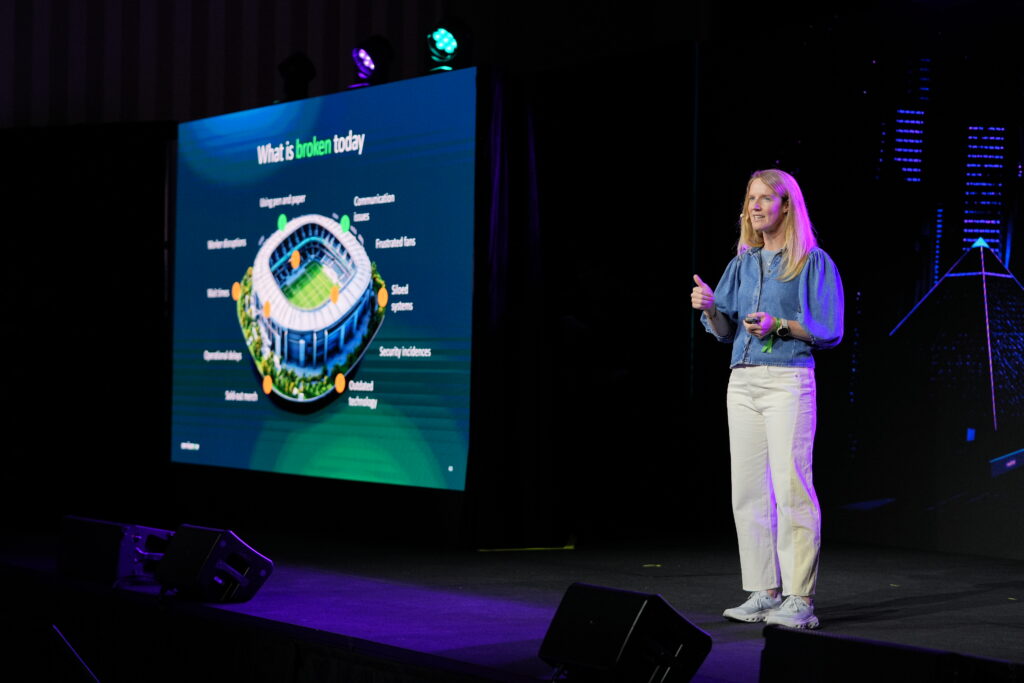
What is a smart stadium?
A smart stadium is a venue where connectivity, sensors, data, and artificial intelligence are integrated so the building operates as a single intelligent system. It manages everything from crowd safety and energy use to ticketing, concessions, and the fan experience in real time. Rather than a stadium that simply contains technology, a smart stadium runs on it.
The defining shift is integration. A traditional venue might have a ticketing system, a security system, a point-of-sale system, and a building-management system that never speak to each other. A smart stadium connects those layers so the data they generate can be acted on together. That is what turns a collection of tools into an intelligent environment.
What makes a stadium “smart”? Three pillars
Speaking at PEAK, Sebastian Lancestremere of Microsoft framed the modern venue around three characteristics: multipurpose, intelligent, and sustainable. That framing is a useful way to understand what separates a smart stadium from a conventional one.
Multipurpose. Smart venues are engineered to host far more than the home team’s games. Lancestremere pointed to designs where the playing surface itself can be reconfigured to clear the floor for other events. He cited Allegiant Stadium and Real Madrid’s Santiago Bernabéu, where the pitch can be moved below ground. His benchmark for sheer utilization was Madison Square Garden, which its operator says traditionally hosts more than 400 events a year, drawing over four million fans, better than one a day.
Intelligent. The “smart” layer is the ability to sense, simulate, and decide. This is where digital twins, IoT sensors, and AI come in. The aim, as Lancestremere put it, is a situational-awareness system that lets operators prioritize and choose the best response in any given moment.
Sustainable. Because a smart venue models its own operations, it can optimize them. Lancestremere described using a digital twin of FIFA World Cup stadiums in Qatar to plan, operate, and simulate. The result reduces energy and water consumption and cuts waste, turning sustainability from a reporting exercise into an operational one.
The core technologies behind a smart stadium
1. High-density connectivity (Wi-Fi 7 and 5G)
Everything else depends on the network. Christian Lau, CTO of the Los Angeles Football Club and BMO Stadium, described a venue so tech-dependent that connectivity is the foundation of the business. BMO Stadium recently completed a Wi-Fi 7 upgrade and added a 5G overlay on top of already-advanced infrastructure.
Most transactions there run through optical self-checkout or Amazon “Just Walk Out” rather than traditional concession lines. So the network has to carry ticketing, payments, and fan connectivity at once. It also has to handle an Olympic-scale load, since BMO Stadium is an LA 2028 venue, competing as Exposition Park Stadium during the Games.
But the network question is no longer settled. On a PEAK panel, one operator recounted asking the CTO of a major European football club what the Wi-Fi requirements for a new build should be. The answer was a question back: why bother with Wi-Fi at all? The argument was that modern 5G is now good enough for the fan-facing experience, with Wi-Fi reserved for back-of-house. Whether to invest heavily in stadium Wi-Fi or lean on cellular is now a live design decision rather than a default.
2. Digital twins
A digital twin is a live virtual replica of the physical venue. According to Lancestremere, the World Cup work in Qatar digitized eight stadiums, every entity plus thousands of sensors and cameras, into a single digital representation. Operators can use that twin to plan, run, and simulate before acting in the real world. Crucially, he expects the cost of building one to fall sharply, moving it from a flagship-venue luxury toward something within reach of far more operators.
3. AI, computer vision, and IoT
A fully instrumented venue generates millions of data points a day, more than any human team can monitor. AI, machine learning, and computer vision make that data usable: anonymized computer vision for crowd safety, flagging an unattended object, or helping keep guests safe, as Lancestremere described. His underlying point was that there is little fundamental difference between a smart stadium, a smart building, and a smart factory. They are all sensor-rich environments managed by intelligence. That cross-industry lineage is why teams adapt so much venue technology from other sectors rather than inventing it from scratch.
4. Cashless, frictionless transactions
Smart venues remove the friction points of the old model (paper tickets, cash, and queues) in favor of digital ticketing, biometrics, and automated checkout. This both improves the guest experience and generates the first-party data that powers personalization. At BMO Stadium, that means biometric identity, autonomous retail, and optical self-checkout designed, in Lau’s words, to be effortless:
“We try to make the technology that we deploy in the building effortless for people. Everything’s designed at human scale, so it’s approachable.”
Christian Lau, CTO, LAFC and BMO Stadium
Designing “smart” in from day one vs. retrofitting
One of the sharpest distinctions in the smart-venue conversation is whether intelligence is built in from the ground up or bolted on later. Both paths were represented at PEAK.
BMO Stadium opened in 2018 having launched on Wi-Fi 5, and has been on a continuous upgrade path ever since. Lau’s point was that this was deliberate. The venue was never meant to be “set and forget,” and was built futureproof where possible, with fiber and conduit in place and a master plan to evolve the tech stack over time. The hardest thing to retrofit, in his experience, isn’t connectivity or software. It’s power.
SAP Garden in Munich, by contrast, was conceived as a digital-first venue from the start. Burkhardt von Wagner of Red Bull, who was there from conception, put the design philosophy bluntly:
“We’re 100% digital, with nothing analog in the whole stadium.”
Burkhardt von Wagner, Red Bull / SAP Garden, Munich

That included going fully cashless from day one. It was a bold move in a cash-loving German market, but von Wagner said it drew far less pushback than the team feared.
His broader lesson was a caution against importing other people’s blueprints. The team toured NBA, NFL, NHL, and MLS venues in the US for inspiration, then deliberately built their own approach rather than copying. As he framed it, “copy-paste will never work,” and technology is not the answer to every question. The first questions to settle are who you are building for and why.
The economics: why “multipurpose” is the real business case
The strongest argument for a smart venue isn’t fan experience for its own sake. It’s utilization. A stadium that sits idle between home games is an underused asset; a smart, flippable venue is a year-round business.
BMO Stadium activates on the order of 310 days a year, and only a fraction of those are ticketed sports events. Two football clubs play there, but the building also hosts boxing, flag football, and conferences. It even runs a substantial film and television production business: studios use the large, well-connected spaces as soundstages and run post-production offsite over the venue’s fiber.
As Lau described it, that production line has little to do with the building being a stadium. It has everything to do with it being a flexible, connected space.
SAP Garden makes a similar bet through community use. Of its four ice rinks, one serves the professional teams and three are rented to the city of Munich for grassroots sport. That creates a decades-long utilization base alongside the marquee events.
The logic now extends beyond the building itself. On a venue-design panel, Populous’s Brian Mirakian described how ownership groups increasingly design not just an anchor venue but the surrounding district: food and beverage, hospitality, workplace, and lifestyle that drive “365 vitality.” The often-cited example is the Atlanta Braves, who reportedly earn more annually from their mixed-use district than from their 80 home dates.
What operators should actually do first
A recurring warning at PEAK was that smart-venue projects fail when they start with hardware. Lancestremere’s prescription was to invert the order and start with the fan, not the kit:
“Think of your customer first. Put the fan at the center. Think before, during, and after the match, and identify two or three experiences that will be a win for the consumer, before you deploy hardware, technology, and facilities.”
Sebastian Lancestremere, Microsoft
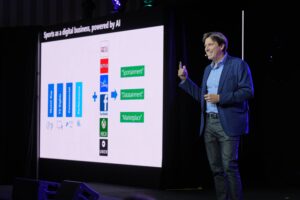
From there, his advice was to unify the data those experiences generate. That means pulling the official app, online store, ticketing, loyalty, sponsorship activations, streaming, and social into a single 360-degree fan profile, the “golden record” familiar from consumer goods. That single profile is what makes everything downstream possible: personalization, sponsorship value, and new revenue.
The hard part: breaking down data silos
If there’s a single obstacle that defines the current phase of smart venues, it’s integration. Julia Martensen of ServiceNow described the goal as a fully connected experience. Her point was that, architecturally, a connected stadium is the same problem as a smart hospital, airport, or city. The barrier, in her account, is rarely a shortage of data; venues already collect plenty about fans, athletes, and workforce. The problem is that the data sits in silos that don’t talk to each other.
Operators echoed this from the inside. Across panels, leaders described the core challenge as connecting teams and systems that each chase the same goal but compete for the same fan. Digital media, traditional marketing, CRM, and ticketing often pull in parallel rather than together. The lesson several drew: the limiting factor is usually execution and organizational alignment, not the technology itself.
Connecting the silos, so intelligence can act on the whole picture rather than fragments of it, is the defining work of the smart venue’s next phase.
Real-world examples of smart stadiums
- SAP Garden, Munich (Red Bull): conceived digital-first and fully cashless, with four ice rinks split between professional and community use. A rare case of designing the intelligence in from day one rather than bolting it on.
- BMO Stadium, Los Angeles (LAFC): a connectivity and frictionless-retail showcase (Wi-Fi 7, 5G overlay, biometrics, optical self-checkout), active ~310 days a year and being readied for an Olympic role in 2028.
- Allegiant Stadium & the Santiago Bernabéu: cited for movable playing surfaces that make a single venue genuinely multipurpose.
- FIFA World Cup stadiums, Qatar: an eight-stadium digital-twin deployment used for planning, operations, and sustainability.
- Madison Square Garden: the utilization benchmark, with 400+ events a year per its operator.
Further reading: Sports Industry Outlook 2026 (PwC), which covers venue-anchored mixed-use districts, leaner operations, and the technology reshaping the fan experience.
Frequently asked questions
What is the difference between a smart stadium and a regular stadium?
A regular stadium contains technology systems that operate separately. A smart stadium connects those systems (connectivity, sensors, data, and AI) so the venue runs as one intelligent environment, enabling real-time decisions across operations, safety, and the fan experience.
What technology is used in a smart stadium?
Core technologies include high-density connectivity (Wi-Fi 7 and 5G), digital twins, IoT sensors, AI and computer vision, and cashless or biometric transaction systems such as optical self-checkout.
What is a stadium digital twin?
A digital twin is a live virtual replica of a venue, its physical assets plus its sensor and camera data, that operators use to plan, monitor, and simulate operations before acting in the real world. The cost of building one is falling, widening access beyond flagship venues.
Do smart stadiums need Wi-Fi, or is 5G enough?
Both are used. Wi-Fi 7 and dedicated 5G overlays are common in advanced venues, but some operators now argue modern 5G can carry most fan-facing needs, with Wi-Fi reserved for back-of-house systems. It is increasingly a deliberate design choice rather than a default.
Why are smart stadiums multipurpose?
Utilization drives the business case. A flippable, connected venue can host concerts, conferences, multiple sports, and even film production year-round. BMO Stadium activates around 310 days a year, turning an asset that once sat idle between games into a continuous revenue source.
What is an example of a smart stadium?
Examples discussed at PEAK include SAP Garden in Munich (designed 100% digital), BMO Stadium in Los Angeles (Wi-Fi 7 and 5G, biometrics, cashless concessions), and the digitized World Cup stadiums in Qatar.
Back to top ↑
subscribe to the Peak insider newsletter
Get exclusive insights and connect with top investors in the industry.