Tracks
  Future of SportsTech Report
  Executive Summit
  Official Hotel
  2026 Speakers
  2026 Photos
  Who Attended
  FAQs
FAQs Sports Performance Analytics in 2027: A $50K Tool Goes Free
 Peak Conference
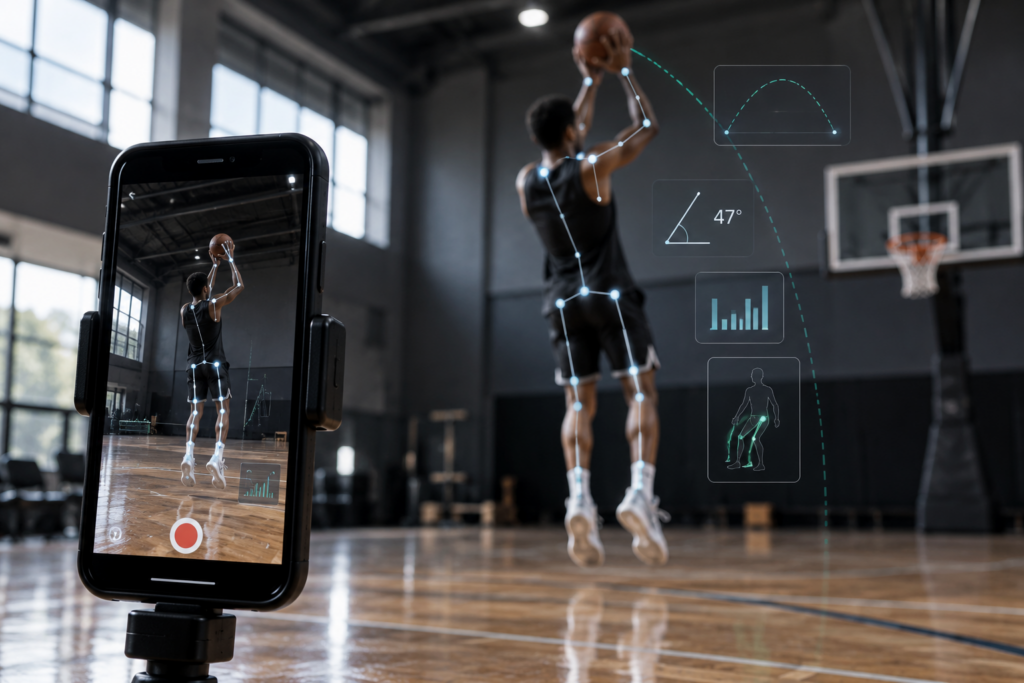
What used to require a $50,000 professional analytics package and a data science team can now run off a single phone camera on the sideline of a middle school gym. That’s the shift reshaping sports performance analytics in 2027. Computer vision, biomechanics, and AI are bringing tools once reserved for professional teams down to youth, school, and recreational sports, and it’s happening across PEAK’s Athlete Performance track.
“A single camera can capture precise data, identify jersey numbers, trained on millions of possessions, and you can create a box score,” said Jason Syversen, founder and CEO of SportsVisio, on the PEAK stage. “So you can take something that’s a $50,000 analytics package and have it at a middle school level. An adult rec league, and have that off a single iPhone or Android phone or a smart camera.”
What is sports performance analytics?
Sports performance analytics is the technology used to capture, analyze, and act on how athletes move and perform. It’s distinct from fan-facing data like ticketing or engagement analytics. In 2027 it spans four layers:
- Computer vision and video analytics: turning ordinary game footage into box scores, tracking, and highlights (SportsVisio, GameChanger, Hawk-Eye)
- Biomechanics and movement analysis: breaking down how an athlete’s body moves to improve performance and reduce injury risk (Uplift Labs, Reboot Motion)
- Wearables and biometrics: heart rate, load, and recovery tracking, the most mature layer, built out over the last decade-plus by devices like Fitbit and Apple Watch
- Athlete data and identity: profiles that follow an athlete from their first youth game through the elite level
What’s changed in 2027 isn’t necessarily the underlying science. For many computer vision and biomechanics applications, the hardware needed has simply become a phone camera. That replaces equipment that used to cost tens of thousands of dollars. Wearables and biometrics remain a more mature, dedicated-hardware layer of the category.
The numbers behind the sports performance analytics shift
65% → 99%
SportsVisio’s gap between an early computer-vision demo and production-level accuracy
$9M
Raised by SportsVisio, mostly spent closing that accuracy gap
22,000+
Athletes in Uplift Labs’ own biomechanics dataset, from youth to elite
~1/3
Of MLB clubs already using Reboot Motion’s cloud biomechanics platform
Case study: the demo-to-product gap almost nobody talks about
SportsVisio’s own founding story is the clearest illustration of why this technology took years to arrive, not months.
Syversen started the company in 2021 and put in half a million dollars of his own money. He hired a team that included a former head of a $200 million AI portfolio and MIT-trained PhDs. Six months in, the demo looked great. Then progress slowed to a crawl.
“It’s not hard to build a really cool demo for a single game in a single instance and get 65% accuracy out of the box,” Syversen said. “But the gap between 65% and 98%, 99% is a chasm, like it is gargantuan. We’ve raised over $9 million with the company, and most of that went into building the computer vision models: tens of thousands of games, annotated training data, many camera angles, multiple courts, dealing with whistles, dealing with ponytails blocking jersey numbers, obscure camera angles, bad lighting, gray lettering on black jerseys.”
That accumulated training data, expensive and slow to build, became the company’s real defensibility. “You can’t just build a computer vision system with 98% accuracy on a weekend, even in six months, because you need the tens of thousands of games with high-accuracy, accurate label data to build accurate models,” he said. “That’s why we raised so much money. But it gives us a moat to new companies.”
What comes after analytics: officiating and scorekeeping
Syversen sees the same computer vision shift eventually reaching officiating and scorekeeping too. “Why are we paying a human $15 per game at a tournament, and you’re paying thousands of dollars to pay a human to press a button when the ball goes in the hoop,” he said. “We can do that with software.” Recreational-level referees typically earn $60 to $100 a game, by his account. That’s an inconsistent, part-time workforce at exactly the level where cost is the biggest barrier to keeping a league running. He doesn’t expect human referees to disappear overnight. More likely, a hybrid model comes first: a couple of cameras, an app, and a head referee agreeing or disagreeing with what the system calls.
One of his favorite examples has nothing to do with elite performance at all: a 43-year-old recreational-league player using the platform to build highlight mixtapes of his own games. It’s the same instinct GameChanger is built around at a larger scale, treating a middle-aged rec player’s Tuesday night game with the same seriousness as a future draft pick’s.
How sports performance analytics is expanding beyond the pros
SportsVisio isn’t the only company betting on the same shift. The other examples make clear this isn’t just a basketball story or a computer-vision story.
Uplift Labs: biomechanics in your pocket
Sukemasa Kabayama, co-founder and CEO of Uplift Labs, is applying the same logic to biomechanics. Before Uplift, biomechanical analysis “was trapped in these performance labs that are prohibitively expensive” and reserved for elite athletes. Uplift’s answer was to build what Kabayama calls “a lab-grade 3D motion capture performance lab in your pocket.” It runs on the same ordinary iPhones and iPads already in nearly every parent’s hand. “That’s really been kind of our journey, from the start to today,” he said. His dataset now spans more than 22,000 athletes, stratified from elite professionals down to youth players. That means the same sports science built for the pros can apply just as well to a 12-year-old.
GameChanger: building for everyone, not just the elite
Sameer Ahuja, President of GameChanger, made the case for building for the entire market rather than just the elite tip of it. GameChanger’s usage runs “from rec elementary school all the way up through high school, and the more elite sports and travel and club.” Ahuja insists the product’s core feature set has to work for all of it.
He pointed to Konnor Griffin as proof of that philosophy. Griffin had just become one of the most talked-about young players in Major League Baseball, the Pirates’ number-one prospect and the first teenage position player to debut since Juan Soto in 2018. He’d been on a GameChanger team just a year earlier. A platform built for a third-grader making friends on a team, in other words, has to be the same one that can carry a future pro. “Your goals as an athlete and your family’s goals, it doesn’t matter to me where they end,” Ahuja said. “We want to do this for everyone, and we can.”
Reboot Motion: built for scale from day one
Jimmy Buffi, co-founder and CEO of Reboot Motion, came at the same problem from the opposite direction. Instead of starting small and scaling up, he built for scale from day one. A former biomechanics analyst for the Los Angeles Dodgers, Buffi left after seeing firsthand how hard it was to turn motion-capture data into anything a coach could actually use. Reboot’s cloud biomechanics platform now analyzes every MLB and NBA game, every day, work that used to take a team of engineers years to build in-house. “Spend less time building technology and more time pushing the limits of human performance,” he said, describing the platform’s purpose.
Where this leaves the established players
None of this displaces the incumbents overnight. Catapult Sports, the wearables and video-analytics company built for professional and Olympic teams, reported $141 million in trailing twelve-month revenue as of March 2026. It’s now targeting $1 billion in annualized contract value, funded in part by its acquisition of soccer analytics firm IMPECT for up to €78 million. Hawk-Eye, owned by Sony, remains the backbone of automated officiating in tennis and soccer’s video assistant referee system. Its skeletal tracking cameras capture 29 points on the human body at high frame rates, without any wearable sensor at all.
The two worlds aren’t as separate as they look from outside. In 2024, Hawk-Eye brought in Reboot Motion, the same company building cloud biomechanics for MLB and NBA teams. The goal was to validate and refine its own 3D player models feeding MLB’s Statcast system. The incumbent needed the newer company’s expertise to check its own accuracy, a sign that the line between the establishment and the democratizers in this category is thinner than it looks.
Common mistakes to avoid
- Mistaking a good demo for a finished product. Syversen’s own experience shows how deceptive the first 65% of accuracy can be. The last several points are where most of the real cost and time go.
- Building only for the elite tier and hoping it trickles down. GameChanger’s approach inverts this: build the base feature set for every level first, then layer elite features on top.
- Underinvesting in the unglamorous data problem. Whistles, ponytails, bad lighting, and gray lettering on black jerseys aren’t edge cases, they’re the actual job. Annotated training data is where the real cost lives, not model architecture.
- Treating the technology as useful only for elite athletes. SportsVisio, Uplift Labs, and GameChanger all point the same direction: tools once built around professional performance are increasingly designed for youth, school, and recreational athletes too, not adapted for them as an afterthought.
Frequently asked questions about sports performance analytics
What is sports performance analytics?
Sports performance analytics is technology that captures and analyzes how athletes move and perform, using tools like computer vision, biomechanics analysis, and wearables. It’s distinct from fan-facing sports data like ticketing or engagement analytics, though both fall under the broader sportstech umbrella.
Why is computer vision suddenly viable for youth and rec-level sports?
The core AI models have existed for years. But reaching the accuracy level needed for real use, typically 98% or higher, requires enormous amounts of annotated training data covering real-world conditions like poor lighting and obstructed jersey numbers. Companies like SportsVisio have spent years and millions of dollars closing that gap. That’s what now allows a single phone camera to replace equipment that used to cost tens of thousands of dollars.
What’s the difference between sports performance analytics and sports data platforms?
Performance analytics focuses on the athlete: how they move, what they did in a given game, and how to help them improve or avoid injury. Broader sports data platforms typically focus on the fan or the business side, ticketing, CRM, and engagement, rather than on-field performance.
What companies are building sports performance analytics technology?
The category includes newer, democratization-focused companies like SportsVisio, Uplift Labs, Reboot Motion, and GameChanger, alongside larger established players. Catapult Sports has historically served professional and Olympic teams and reported $141 million in trailing twelve-month revenue as of early 2026. Hawk-Eye, owned by Sony, powers automated officiating in tennis and soccer’s video assistant referee system.
Is sports performance analytics only useful for professional athletes?
No. The companies driving this shift are explicitly targeting youth, rec-league, and school-level sports. They argue the same tools built for professional teams can now reach a middle school gym or an adult rec league at a fraction of the historical cost.
Why this is an Athlete Performance track conversation
Athlete Performance is one of PEAK 2027’s six core tracks, covering the technology changing how athletes train, compete, recover, and develop. SportsVisio, Uplift Labs, GameChanger, and Reboot Motion all share the same through-line running through PEAK’s youth sports technology coverage. Tools that used to be reserved for the top of the sport are moving down-market fast, and the companies winning are the ones willing to do the unglamorous, expensive work of making that possible.
For the fuller data picture across the industry, see PEAK’s SportsTech Report.
Discounted tickets on sale now
Meet the companies putting pro-level performance tools in everyone’s pocket.
Discounted tickets are on sale now, and Sports Organization passes are 100% funded by application. March 31–April 2, 2027 · Fontainebleau, Las Vegas.
Back to top ↑

subscribe to the Peak insider newsletter
Get exclusive insights and connect with top investors in the industry.