Speakers
  Tracks
  Future of SportsTech Report
  Executive Summit
  Startup World Cup 2027
  Official Hotel
  2026 Photos
  Who Attended
  FAQs
FAQs Fan Engagement in 2027: Why Shared Experiences Beat Personalization
 Peak Conference
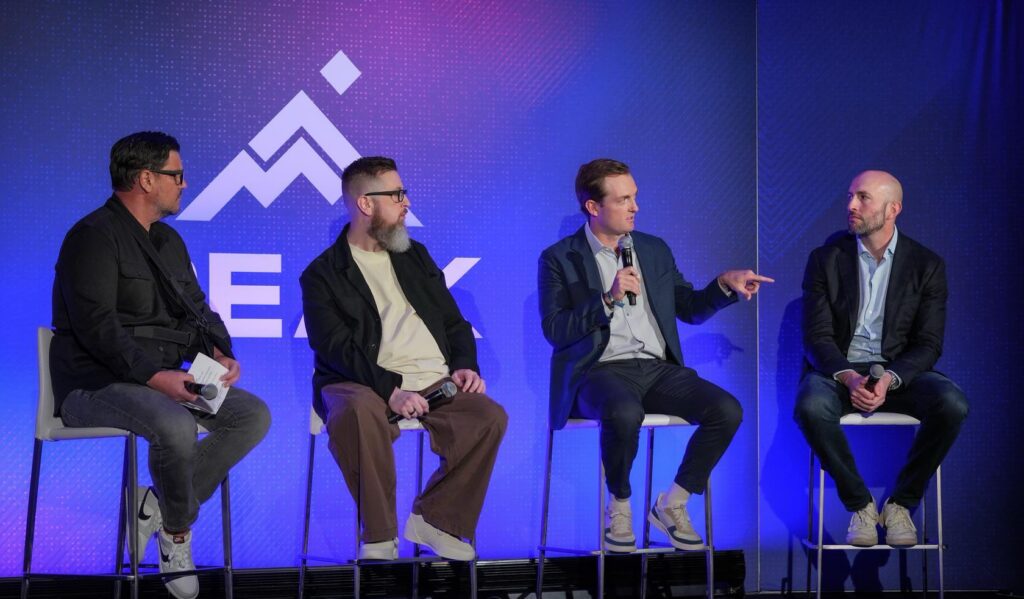
Ask most sports organizations what their fan engagement strategy is, and you’ll hear some version of the same answer: personalize everything. Tailor the app, tailor the offers, tailor the content, one fan at a time. Across multiple PEAK 2026 discussions, the same concern surfaced. Personalization at all costs can quietly erode the thing that made fans show up in the first place, the shared experience of being part of a crowd.
PEAK’s own report frames this as a broader shift in how the industry is thinking. Last year, sports executives ranked their top three drivers of innovation as revenue, fan impact, and brand value. The 2026 stage conversations kept those same three drivers, but reframed what counts as a win under each one. On fan impact specifically, the question moved from “how do we personalize the fan journey?” to “how do we personalize without losing community and authenticity?”
Underneath that debate sits a more basic problem most organizations haven’t solved yet. Before a team can personalize anything, it needs to actually know its fans, and most still can’t. Fan data lives in six to eight different systems that were never built to talk to each other. Fixing that plumbing comes first. Deciding what to personalize and what to protect as a shared moment comes second. That order is what PEAK’s Fan Engagement track is built around for 2027.
What does a fan engagement strategy look like in 2027?
Based on what’s actually being built and prioritized by sports organizations right now:
- Unified fan data platforms: connecting ticketing, CRM, marketing, and commerce into a single fan identity
- AI-driven personalization: part of the broader shift toward AI across sports, here applied to tailored offers, content, and communication built for the individual fan journey
- Shared experience design: deliberate investment in collective moments, community, and ritual, not just one-to-one personalization
- Loyalty and rewards infrastructure: programs that span ticketing, retail, and content instead of living in a separate app
- In-building and outside-the-building engagement: reaching the much larger share of fans who never attend a game in person
The numbers behind the fan engagement gap
79%
Of execs lack a unified first-party data strategy
6-8
Platforms teams stitch together just to know their fans
68%
Say replacing legacy systems is a top priority
21%
YoY attendance growth after unifying fan data
3.75x
Increase in multi-game attendance, same pilot
These numbers come directly from PEAK’s own 2026 Future of USA SportsTech Report. 79% of sports executives say they lack a unified first-party data strategy. Teams commonly stitch together six to eight separate platforms just to answer basic questions like who their fans are, what they’re buying, and what’s working. 68% say replacing that legacy infrastructure is a very important priority for the next 12 to 24 months.
The upside for organizations that fix this first is real. In an Arizona Diamondbacks pilot of the fan experience platform Jump, year-over-year attendance grew 21% and multi-game attendance grew 3.75 times. That’s not a personalization result. It’s what happens when a team can finally see its own fan data in one place. Every downstream fan engagement tactic, personalization included, depends on that foundation being solid first.
The problem: teams know their fans, just not all at once
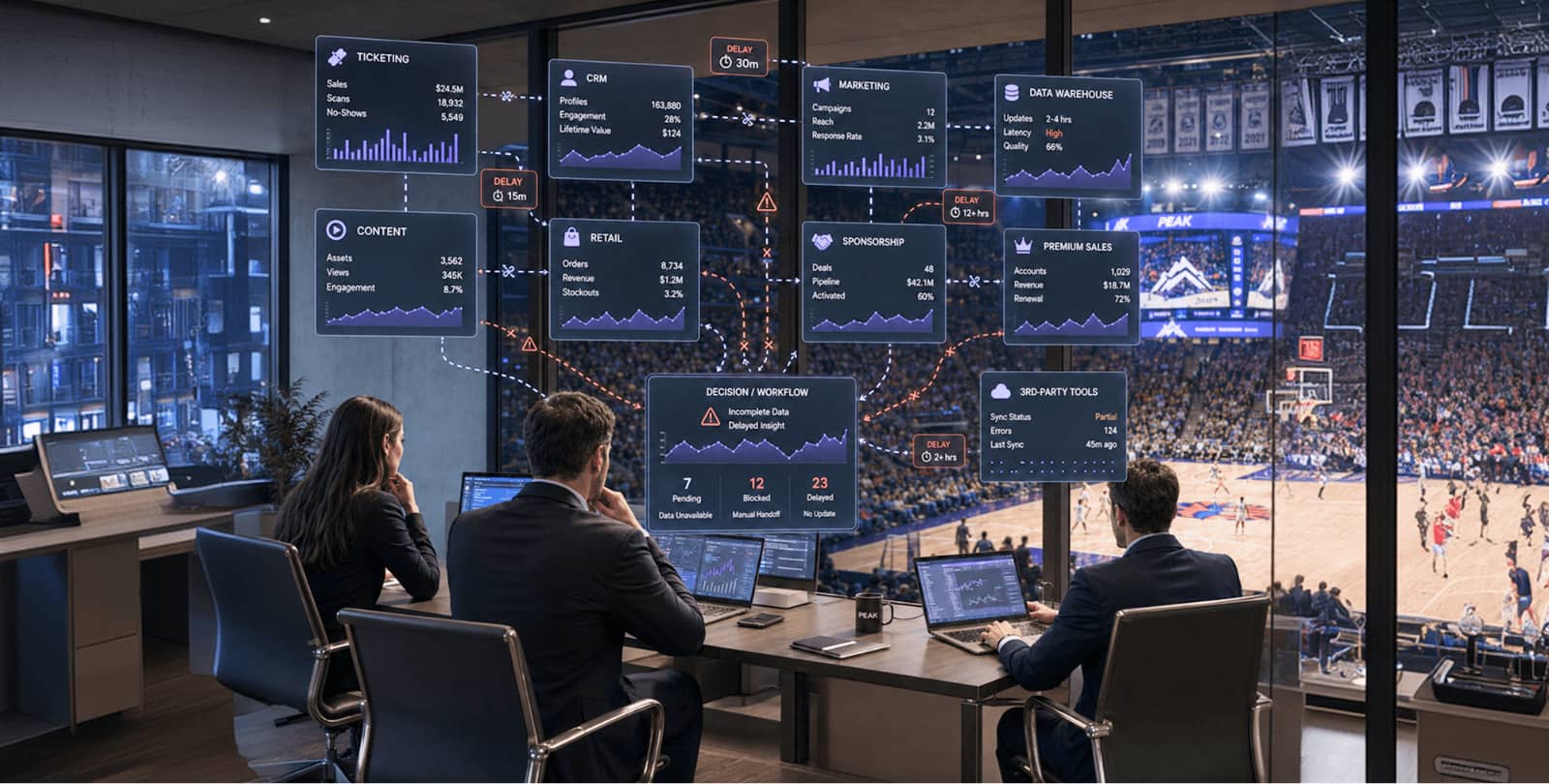
Per PEAK’s report, most professional teams operate inside software environments that were never designed to work together. Ticketing, CRM, marketing, data warehouses, content platforms, retail, sponsorship, premium sales, and third-party tools often sit in separate systems. Teams can collect fan data, but it doesn’t move cleanly into the workflows where decisions actually get made.
Jason Andrea, Chief Revenue Officer of the Las Vegas Aces, described the practical version of this problem at PEAK 2026: “The social component was just the first step. Next is building the stack of how you communicate on a regular basis, which we’ve changed over the last 18 months. At the team level, we don’t always have the foresight to understand what technology is out there.”
The report lists the same pattern from a different angle. Marketing, CRM, ticketing, retail, and digital properties live in silos. There’s no single identity layer across the full fan journey. Sales and service teams spend too much time logging activity instead of actually selling. Insights get found in one system. The action has to happen in another. And increasingly, AI simply cannot operate effectively without unified data and workflow context to work from.
Case study: how one fan experience platform lifted attendance by unifying the stack
Jump is the case study PEAK’s report highlights for this problem. It’s a unified platform combining ticketing, CRM, marketing, fan identity, and revenue operations into a single system. It was built from scratch specifically for sports rather than adapted from general-purpose enterprise software. Jump has since launched with NBA and WNBA teams including the Minnesota Timberwolves and Lynx. The company was founded in 2021 by e-commerce entrepreneur Marc Lore, MLB veteran Alex Rodriguez, and Jordy Leiser. Jump raised $60 million in funding, per AlleyWatch’s October 2025 coverage of the round.
In an Arizona Diamondbacks pilot cited in PEAK’s report, 50% of premium online buyers on the platform were new-to-file. Fewer fan support tickets were generated along the way. Teams on Jump can model and apply pricing changes across their entire ticket inventory in minutes. That’s work that previously took hours of manual effort spread across multiple systems. Sales reps get a full contextual fan summary instantly, purchase history, engagement, and behavioral data together, instead of digging through a CRM and three other platforms to piece it together.
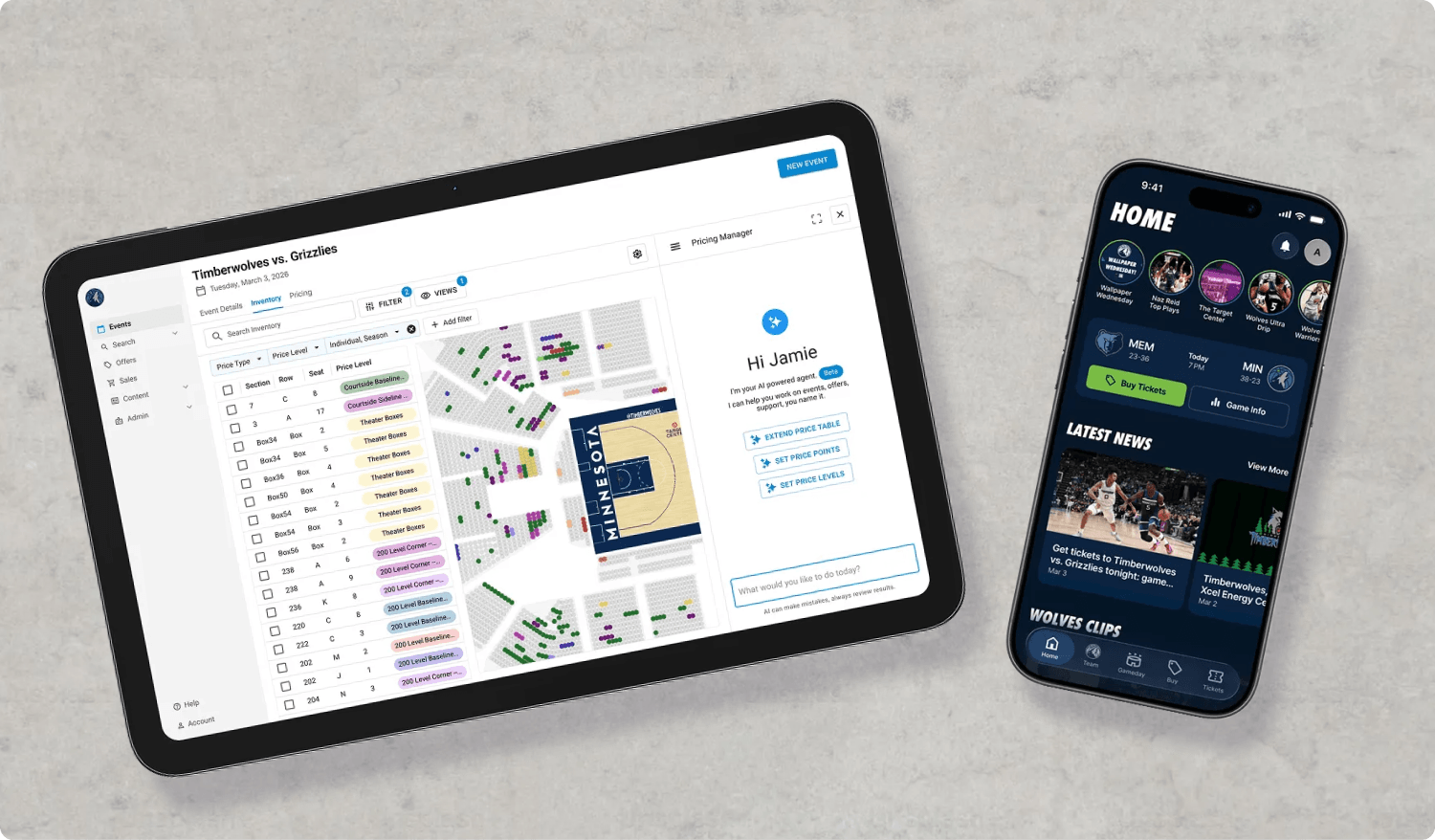
“The reality is that the teams don’t actually lack ideas or data entirely,” said Edward Khoury, CTO of Jump. “What they lack is the ability to connect everything and actually execute. AI changes that not because it makes teams smarter, but it makes the whole organization much faster.” The results in that pilot were substantial: 21% year-over-year attendance growth, a 42% year-over-year increase in single-game sales, and a 3.75 times increase in multi-game attendance.
Why shared experiences beat personalization
Personalization itself isn’t the problem. Across industries, companies that get it right generate 40% more revenue from personalization than slower-growing peers, according to McKinsey. But once the data problem is solved, PEAK’s 2026 stage discussions landed on a genuinely counterintuitive point about how far to take it. Per PEAK’s report, an unexpected through-line ran across panel after panel. It was pushback on the “personalization at all costs” narrative that’s dominated fan engagement thinking for years. From one PEAK 2026 panel on fan engagement: “Personalization shouldn’t come at the detriment of shared experiences.”
The winning approach, per the report, combines AI-driven personalization for individual fan journeys with deliberate investment in collective moments, community, ritual, and identity. Those are the things that don’t personalize well but are exactly why fans show up together in the first place. That distinction also shows up in how organizations are thinking about content and authenticity. “AI is making authenticity a bigger deal than it’s ever been,” said Brian Hough, co-founder and CEO of Press Box. “Anybody can use AI to spit out tons of drivel and slop on the internet, but if you have created an authentic connection with your fan, I think it drives that community ultimately.”
How to build a fan engagement strategy in 2027
Put together, PEAK 2026’s fan engagement conversation breaks into three steps, in order. Unify the fan data first, since personalizing anything is impossible without it. Then personalize deliberately, without sacrificing the shared, in-the-building moments that built the fan relationship to begin with. Then protect authenticity as the long-term asset that AI-generated content can’t easily replicate.
Qiava Martinez, SVP, Chief Sales Officer of the Las Vegas Raiders, framed the stakes in practical terms at PEAK 2026: “The biggest priority I see for sports organizations again has to do with fan engagement. How do we continue to engage our fans that are not only in the building but outside of the building? So technology is a huge factor in how we do that.” She described attending PEAK specifically to find vendor technology her team could bring back to Allegiant Stadium. That’s the same build-versus-buy question Jump’s case study answers directly, just told from the buyer’s side instead of the vendor’s.
Common fan engagement mistakes to avoid
- Personalizing at the expense of shared experience. PEAK 2026’s own panels pushed back on this directly. The winning playbook keeps deliberate collective moments alongside individual personalization, not instead of it.
- Buying more platforms instead of unifying the ones you have. Teams commonly run six to eight separate systems already. Adding a ninth rarely fixes the underlying identity problem.
- Treating fan engagement as only what happens inside the building. Most of a team’s fan base never attends in person. A strategy built only around gameday misses most of the actual audience.
- Chasing AI content volume over authenticity. As AI-generated content becomes the norm everywhere, genuinely authentic fan connection becomes the harder, more durable differentiator, not the easier one to automate away.
Frequently asked questions
What is fan engagement in sports?
The practice of building a relationship between a sports organization and its fans across every touchpoint: ticketing, content, loyalty, and in-venue experience, not just gameday attendance. In 2027 that starts with unifying fan data across the platforms a team already runs. Personalization and shared, collective experiences get layered on top of that foundation, not built before it.
Why do sports teams struggle with fan engagement technology?
Mostly a data problem, not a strategy problem. Per PEAK’s 2026 report, 79% of sports executives lack a unified first-party data strategy. Teams commonly run six to eight separate platforms that don’t share fan data cleanly. Insights often exist somewhere in the organization, but the systems where action actually happens are disconnected from them.
Does personalization always improve fan engagement?
Not on its own. PEAK 2026’s stage discussions pushed back specifically on “personalization at all costs.” Shared, collective experiences, community, ritual, and identity, matter just as much and shouldn’t be sacrificed for one-to-one personalization.
Where can sports executives learn about fan engagement technology in person?
PEAK 2027’s Fan Engagement track is built specifically around this. Sessions and Solution Huddles connect sports organizations directly with the companies building unified fan data, personalization, and loyalty platforms. See the full breakdown of sports conferences worth attending in 2027 to compare PEAK with other events covering this space.
Why this is a Fan Engagement track conversation, not just a technology one
Both examples above sit at the intersection of a real operating problem and a technology decision that happened to solve it. That’s the exact framing behind PEAK’s Fan Engagement track, one of six tracks running at PEAK 2027 alongside Revenue Strategy, Business Operations, Smart Venues, Athlete Performance, and Media & Broadcasting. Solution Huddles put sports organizations directly in the room with the companies building unified fan data platforms and personalization tools. Those are the same categories Andrea, Khoury, and Martinez described on stage.
Discounted tickets on sale now
Build your 2027 fan engagement strategy at PEAK
Discounted tickets are on sale now, and Sports Organization passes are complimentary by application. March 31–April 2, 2027 · Fontainebleau, Las Vegas.
Related reading: Sports Revenue Streams in 2027: How Teams Are Finding New Growth | Smart Venues: What’s Next for Stadium Technology | The Future of Sports Technology | The Sports Conferences Actually Worth Attending in 2027
Back to top ↑
Subscribe to the PEAKCONF Insider Newsletter
Get exclusive insights and connect with top investors in the industry.