Speakers
 Tracks
 Who Attends
 Attending NAB?
 Networking Programs
 Official Hotel
 Why Attend
 Solution Huddles
 Executive Summit
 Startup World Cup
 Exhibit & Sponsor at PEAKCONF
 2026 Event Photos
 FAQs
 Blog & News
 Future of USA SportsTech Report
Sports Ticketing Technology in 2027: From Selling Seats to Fan Commerce
 Peak Conference
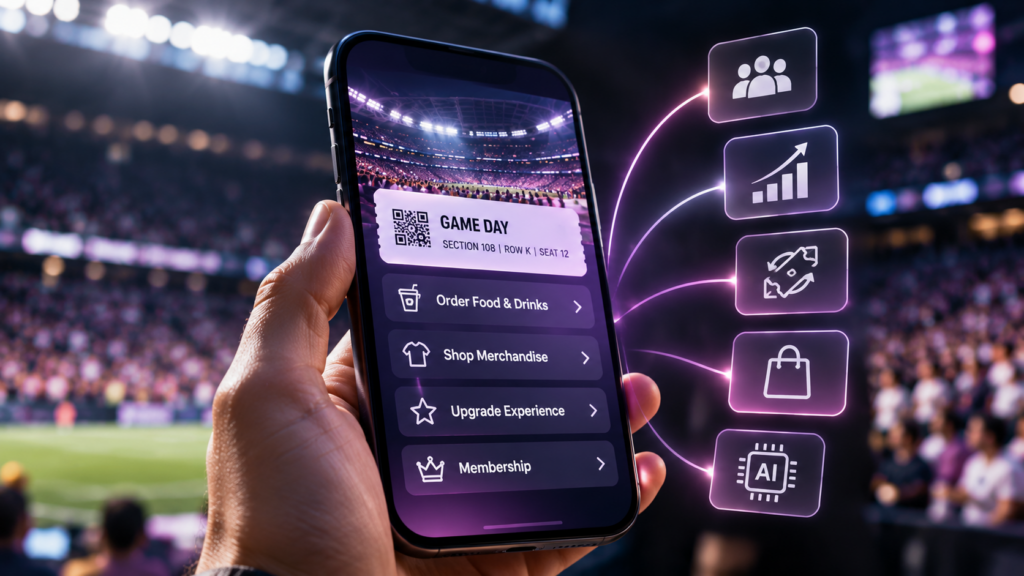
For years, the ticket was the end of the transaction. In 2027, sports ticketing technology treats it as the start of the fan relationship. On the PEAK stage, the moderator of one ticketing panel put it simply: the gate “used to just be a door,” and now it is “a data layer,” “a payments rail,” and “fraud control.” It is also “the first real experience for a fan.”
Drawing on discussions at PEAK and industry research, we explore who owns fan data, how pricing and resale are changing, what teams sell at checkout, and where AI agents fit.
What is sports ticketing technology?
Sports ticketing technology is the set of systems that sell, price, distribute, scan, and verify tickets. Increasingly it includes the commerce and data layers built on top. In 2027, it usually spans five layers:
- Primary sales and pricing: inventory, price changes, and on-sale management.
- Resale, transfers, and distribution: where else tickets appear, who receives them, and who sees the buyer.
- Access control: scanning, identity checks, and fraud prevention at the gate, a layer that also underpins the smart stadium.
- Fan data and CRM: who the buyer is, and what they do next.
- Commerce: food, merchandise, hospitality, and memberships added at checkout.
PEAK’s ticketing sessions touched every layer. The through-line was that the ticket is only the entry point.
Sports ticketing trends in 2027: Four numbers to know
May 12, 2025
Date the FTC’s all-in pricing rule took effect for live-event tickets
40%
Year-over-year fan growth Formula E reported at PEAK, which a speaker linked to its ticketing effort (metric not defined)
83%
Share of Diamondbacks online premium buyers new to the team, per Attend CEO Aaron Holland
5%
Share of tickets MotoGP sells itself, per Gorka Llort; promoters sell the rest
The Formula E, Diamondbacks and MotoGP figures were shared by speakers at PEAK and reflect their respective organizations, rather than industry-wide benchmarks.
Who is actually in the seats?
The biggest ticketing problem at PEAK was not selling seats. It was knowing who sat in them.
The data gap behind the gate
Gorka Llort, Director, Digital Business at MotoGP Sports Entertainment Group, explained how his sport works. Local promoters sell most tickets. MotoGP holds a small license and sells about 5%. That does not mean it ignores the rest, he said: “the 95 is the highest volume.”
Resale makes it harder. One panelist noted that a fan who buys on a secondary marketplace stays invisible to the organizer: “the event will never know who is actually attending, who paid to be there.” Even on primary sales, a friend who buys three tickets may mean only one fan is known.
The panel’s answer was to capture data around the ticket. Llort said that if teams cannot get data from the buyer, anything surrounding the experience can feed the database. Lee Zohlman, Director of Americas at Formula E, described staff with tablets running quick fan surveys all day at races, which produced “boots on the ground data.”
Why fan apps are not enough on their own
Apps are one way to capture data, but they have limits. Llort admitted that many fans ignored his team’s companion app: “they just don’t use it because they don’t see the value.” His conclusion was that the app has to offer something fans actually want.
David Lane, CEO of Sports Illustrated Tickets, framed ticketing as the starting point for that value. “Everything for a fan to be at that moment starts with the ticket,” he said, and his company uses it “to create a better experience.”
Dynamic pricing, resale, and the rules
Pricing is changing in three ways: how fast teams can adjust it, how much they know about resale, and what regulators now require them to show.
Faster pricing changes
Edward Khoury, CTO of Jump, told the Day 2 breakout audience that teams can now “model and apply pricing changes across their entire inventory in minutes.” What used to take weeks in older systems, he said, now happens in a single workflow. Jump’s February 2026 launch announcement describes pricing and inventory agents that cut that work from hours to minutes. Faster changes show operational speed, not that prices are more profitable or fairer. These are vendor claims, so ask for customer evidence.
Reading the secondary market
Gene Tinner, SVP at UFC, described using AI to track secondary markets such as StubHub. UFC also uses AI to research past pricing before returning to a city it has not visited in years. He added a caution: when the AI’s boxing data did not match, his team trusted the numbers it already held in-house.
Buyers who wait
Timing is also shifting. Zohlman said fans in Miami tend to buy a day or two before the race. An INTIX 2026 trends piece reports that Megan Christensen of USA Water Polo sees buyers increasingly waiting until close to the event, partly because resale inventory is easy to find.
All-in pricing
The FTC’s rule on unfair or deceptive fees took effect on May 12, 2025. Under the FTC’s guidance on the rule, sellers must disclose mandatory fees upfront in the advertised price of live-event tickets. Dynamic pricing is not prohibited, as long as the full total is shown. TicketNews adds that it applies at every stage of purchase, including resale.
Fan commerce: turning checkout into a storefront
Fan commerce means selling more than the seat. Robert Davari, CEO of Tixr, argued that “ticketing powers commerce.” Add food, beverage, merchandise, and hospitality to the checkout, he said, and fans buy more. He added that a great fan experience means not pushing people “to a bunch of different channels to sell.”
Davari said Tixr sells many hotel and VIP packages, and that memberships anchored by ticketing can reach fans who never set foot in the stadium. These are his company’s claims, though the membership trend is visible elsewhere. PwC’s January 2026 analysis cites the St. Louis Cardinals’ Budweiser Ballpark Pass and Atlanta United’s ticket sell-back option as examples of memberships replacing the traditional season ticket.
Premium sales online
Attend CEO Aaron Holland described the Arizona Diamondbacks putting suites and premium seating online for the first time. He said 83% of those buyers were new to the team. His reading was that some fans “may pay more not to talk to someone.” That figure is his own. Still, online premium sales can help teams reach buyers who may never have engaged with a traditional sales representative.
Memberships as data
Phil Andrews, CEO of USA Fencing, took a different route. His organization made parent memberships free, which gives it two extra members each time someone under 18 signs up. Andrews said the additional member data helped USA Fencing rank second among national governing bodies for monetization per member. That ranking was reported by Andrews during his PEAK session.
AI agents in ticketing: from insight to action
At PEAK, the discussion shifted from AI-assisted analysis toward systems that can execute ticketing tasks themselves. Khoury said that for 30 years software helped people do the work, and now “software is actually doing the work.” One client’s ticketing staffer told him the tools had changed their life.
He also argued that none of this works on fragmented data: “You can’t get to agentic AI if your data is fragmented.” That echoes a warning from the Houston panel. One panelist recounted speaking with an NBA team that deployed an LLM across its full data set, then had to switch it off because sensitive data was not segregated and was visible to everyone. The team later fixed it, he said. This is a stage anecdote, not a verified public incident.
Donny White, CEO of Satisfi Labs, went further. He predicted a future in which “the fan agent and the ticketing agent will negotiate the sale and then transact without either side actually having a human conversation.” That is a forecast, not a product teams can buy today.
Panelists also stressed the human side. One said trust “can be lost faster than efficiency can be gained.” Another noted that some fans still want a person. One live-event team added a staffed table for premium upsells instead of moving everything online.
How sports organizations evaluate ticketing technology
Houston Astros ticket operations director Trevor Purvis said his team no longer chases every new tool. “We are looking for solutions to solve problems that we have right now, or will have in the future.” Timing matters most. Will it solve a problem in the next homestand, or the second half? He wants “solutions that are lightweight, that we can implement fast.”
Drawing on these sessions, here is a short checklist for evaluating ticketing technology. It is our synthesis, not a PEAK framework:
- Problem fit: Which specific problem does it solve, and by when?
- Speed to launch: Can it go live before the problem moves on?
- Data ownership: Who sees the fan record, including on resale?
- Fee transparency: Does the checkout show an all-in price?
- Integration: Can it connect with existing ticketing, CRM, access control, and commerce systems without creating another data silo?
- AI safeguards: Is sensitive data segregated, and is output checked against your own numbers?
Common mistakes to avoid
- Treating the ticket as the end of the journey. At PEAK it was consistently described as the start.
- Ignoring the resale blind spot. Limited visibility into the final attendee makes personalized offers and ongoing fan relationships harder to build.
- Launching AI on unsegregated data. The NBA anecdote shows how quickly it can go wrong.
- Pushing everything online. Some premium buyers want a person, and a staffed table can surface offers they did not know existed.
- Quoting vendor results as benchmarks. Most of the figures above came from the speakers’ own companies.
Frequently asked questions about sports ticketing technology
What is sports ticketing technology?
It is the systems that sell, price, distribute, scan, and verify sports tickets. It also covers the data and commerce layers on top.
How do sports teams use AI in ticketing?
Panelists described AI for pricing changes, tracking secondary markets, researching past events, and warming up sales leads. Vendors also showed agents that change prices and manage inventory in minutes.
What is fan commerce?
Fan commerce is selling more than the seat at checkout: food, merchandise, hospitality packages, and memberships. Tixr’s Robert Davari argued that ticketing is the foundation for all of it.
Why don’t teams know who attends when fans buy on resale?
When tickets are resold through third-party marketplaces, organizers may not receive the final buyer’s information. That can leave teams without a full picture of who attends, especially when tickets are transferred or resold outside their systems.
What does the FTC all-in pricing rule mean for sports tickets?
Since May 12, 2025, sellers must disclose mandatory fees upfront in the advertised price of live-event tickets. Demand-based pricing is still allowed if the full total is shown.
How should a sports team evaluate new ticketing technology?
Start with a specific problem and a deadline. The Astros’ Trevor Purvis looks for lightweight tools that can be implemented fast.
Why this is a Fan Engagement and Revenue Growth conversation
Ticketing sits where two PEAK 2027 tracks meet. Fan Engagement asks how to build the relationship, and Revenue Growth asks how to monetize it. Both start at the gate. For more on how shared experiences drive loyalty, see PEAK’s fan engagement analysis and its look at sports revenue streams. The measurement side is covered in sports sponsorship tracking.
For the wider data picture, see PEAK’s SportsTech Report.
Discounted tickets on sale now
Meet the sports executives and technology leaders shaping the future of fan engagement and revenue.
Discounted tickets are on sale now, and Sports Organization passes are 100% funded by application. March 31–April 2, 2027 · Fontainebleau, Las Vegas.
Back to top ↑

Subscribe to the PEAKCONF Insider Newsletter
Get exclusive insights and connect with top investors in the industry.