Tracks
  Speakers
  Schedule
  2026 Photos
  Who Attended
  PEAK Night Summit
  FAQs
FAQs  Future of SportsTech Report
 SportsTech Startups: How They Break Into the Industry
 Peak Conference

SportsTech startups are transforming every corner of the sports industry. That spans athlete performance, officiating, fan engagement, media, and smart venues. But breaking into professional sport is notoriously difficult. This guide explains how successful sports technology startups win customers and attract investors. It also shows how they scale inside one of the world’s most relationship-driven industries.
What are sportstech startups?
SportsTech startups are the companies building the technology that runs modern sport, from athlete performance and officiating to ticketing, fan engagement, and venue operations. At PEAK, hundreds of them filled the Tech Expo floor and two pitch competitions, and a clear picture emerged of how the successful ones break in. The short version: in sport, you do not sell technology. You solve a named problem for a buyer who can be fired if it does not work.
That distinction runs through everything below. The startups that struggle arrive with a clever product in search of a use. The ones that win arrive with an answer to a problem a league or team has already said out loud.
The SportsTech startup market in 2025
The sportstech market has matured from a niche into a serious industry, and the numbers show it.
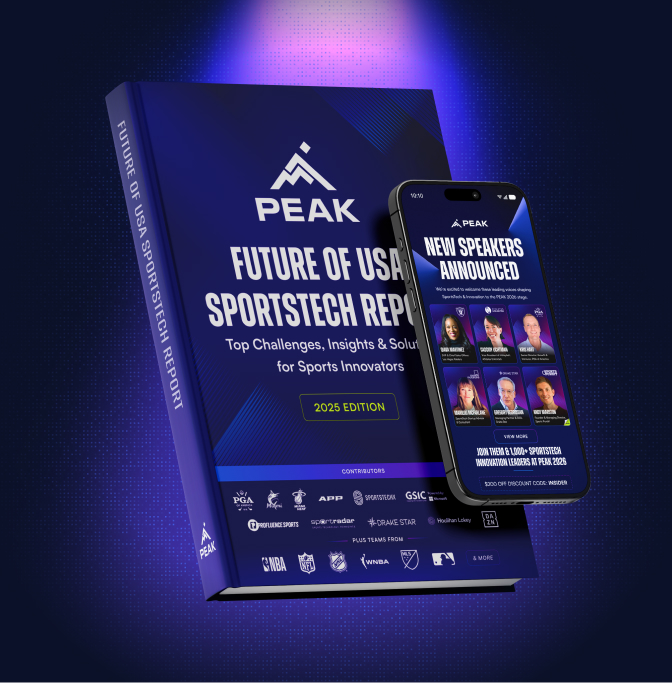
- Global deal flow: sportstech drew about $58 billion in global investment from 2020 to 2024, according to PEAK’s Future of USA SportsTech Report.
- The US leads: the United States accounted for roughly 56% of that global investment, the single largest share of any market.
- Funding trends: capital has grown more selective since the 2021 peak, concentrating in proven businesses and larger rounds rather than spreading thinly across early-stage bets.
- Investors and accelerators: by SportsTechX‘s count, roughly 1,000 investors, accelerators, and innovation programs now serve founders worldwide, most of them in North America and Europe.
- The rise of AI: artificial intelligence has become the fastest-growing theme in the sector, cutting across performance, officiating, fan engagement, and the front office.
The pattern is consolidation and confidence. The lean years cleaned up the market, and the money that remains is more selective. For founders, that means a larger but more discerning pool of capital.
Types of SportsTech startups
The market is broad, but most sportstech startups cluster into a handful of categories. The main ones at PEAK were:
- Athlete performance. Wearables, computer vision, and readiness tools that measure and improve how athletes train and recover.
- Fan engagement. Apps, gaming, and personalization that deepen the bond between teams and supporters, increasingly aimed at Gen Z.
- Smart venues. Connectivity, digital twins, and operations technology for modern stadiums and arenas.
- Media and content. Streaming, production, and creator tools that reshape how the game is watched.
- Ticketing and commerce. Pricing, access, payments, and the emerging wave of AI-native and agent-led purchasing.
- Youth sports. Tools that bring elite-level technology down to schools, clubs, and rec leagues.
- Officiating technology. Computer vision and tracking that support referees and protect the integrity of the game.
- Sports analytics. Data platforms that turn raw tracking and event data into decisions, the home of many sports analytics startups.
- AI-powered front offices. Agents and automation that run ticketing, service, and operations inside the business, a fast-emerging home for sports AI startups.
Two forces cut across all of them. The first is artificial intelligence, increasingly the engine behind every category. The second is data, the raw material each one depends on.
Sport runs on problem statements, not pitches
The clearest model on display came from the Groundbreakers Challenge, run by the Global Sports Innovation Center (GSIC) and powered by Microsoft. Its method inverts the usual startup pitch. Rather than founders guessing what sport needs, GSIC collects real problem statements from sports organizations. Then it goes to the market to find sports innovation startups that can solve them.
At PEAK, those challenges came from organizations like FIFA, Borussia Dortmund, La Liga, the U.S. Soccer Federation, Sevilla FC, and Villarreal CF. Startups pitched live to the people who could actually pilot their solution. GSIC says it has spent more than ten years connecting the industry. It has worked with over 500 organizations across 70 countries, scouted more than 1,500 startups, and brokered over 600 connections. It runs certified pilots through a Sports Testing Lab.
The lesson for founders is blunt. The fastest route in is not a clever product. It is a clear answer to a problem a buyer has already named.
The problems startups are actually solving
The examples at PEAK were concrete. FIFA’s innovation team described adapting body-camera technology, familiar from law enforcement, into a first-person referee body camera that improves transparency and the fan experience, now used across the 2026 World Cup. Another solution used a haptic device to translate the live position of the ball into touch. That lets blind and low-vision fans follow the game inside the stadium. A new fan card was also set for deployment across the World Cup.
Other founders focused on the athlete. ironmind.ai pitched a mental-readiness platform that ingests data from wearables like Garmin and Apple. It flags stress and recovery before something breaks, on the argument that sport measures the body closely but the mind barely at all. Another turns a single phone camera into the kind of performance analytics once reserved for elite teams.
Fan-facing startups leaned into a generational shift. One, RIVAL, builds for what it calls the playing generation: Gen Z fans for whom games are the primary passion point, not film or music. Another reimagined live video as one production in many formats at once, so a single feed can serve broadcast, vertical mobile, and tailored cuts for different audiences. The common thread is not the technology. It is a specific, unmet need.
Inside the pitch: how startups actually compete
Getting noticed in sport tends to run through one of two doors, and PEAK staged both. The first is the problem-statement route, where GSIC matches a startup to a challenge a league has already posted. The second is the open pitch, and PEAK’s Startup World Cup showed exactly what that demands.
The format was tight. Eight startups, four minutes to pitch, two minutes of questions from the judges. They were scored on three things. First, how well the solution fits a real market problem. Second, the quality of the pitch itself. Third, an X-factor: anything that made a judge lean in, from traction to sheer presence. First prize was $10,000 in cash plus $10,000 in cloud credits, with the runners-up taking credits too.
The judging panel was itself a map of who backs sportstech. It included an early-stage investor in the sport economy and a cloud provider’s sports lead. It also included a London scout who advises teams on what to adopt, and a regional hub recruiting startups to a sports-dense state. Win that room over and you have a customer, an investor, and a distribution partner in the same place.
The pitches that landed were specific. The winning founder built a product around a single broken number. Of the roughly $30 billion spent each year on athlete appearances, by their estimate around 60% go unfulfilled. Their fix was a live, one-minute video meeting between fan and athlete, framed as cameo meets FaceTime. Another finalist, RIVAL, pitched a hard demographic thesis. For Gen Z, games have replaced film and music as the primary passion point. So fan engagement has to start where they already play. In both cases the hook was not the technology. It was a sharp, named problem.
What the buyers actually want, and what kills deals
If a problem statement gets a startup in the door, the buy-side reality decides whether it survives. Operators at PEAK were candid about how hard selling into sport is. The first warning was about readiness, because elite sport is unforgiving.
“Pro sports is a game of inches. It can be a game of centimeters. It’s not life or death, but for the people in the club, you could be fired if you lose too many games. So it is a bit life or death.”
Jess Brodsky, Chief Commercial Officer, PlayerData
In Brodsky’s words, PlayerData is famous for saying no. It turned down a top-tier soccer client two years ago because the product was not ready. It only took on a major first-team client once it was. Do not chase the marquee logo before you can support it. Win where you are strong, then grow into the harder rooms.
The second warning was about priorities. Much of what startups sell is a nice-to-have, and a nice-to-have loses to a need-to-have every time. Buyers told founders they had to fix a creaky point-of-sale system before considering anything new. It was not a price objection. It was a priorities objection. Many organizations carry day-one problems, like a shaky data foundation, that must be solved before any clever AI can sit on top.
A third pressure is build-versus-buy, and it is intensifying. Buyers increasingly ask why they cannot just build the thing themselves with AI tools. The strongest answer founders gave was to reframe it around focus: is this your core competency, and is it how you want to spend your time? One founder even described a new friction in negotiations. Their contracts now get fed into AI tools by the buyer, so they are effectively negotiating against a model, not just a person.
The founders who handled this well reframed the premise rather than fighting it. One sat down with a team that already had data and tools. Generic copilots could not produce the outputs it needed, so it hard-coded models against the team’s own data. The real lesson: buyers want fewer tools, not more. The objection that nearly sank deals was data security, solved by keeping everything in the buyer’s own cloud.
The relationship can still curdle after the sale. Operators described the vendor sins that lose renewals: treating a client like just another account number, assigning a contact who does not understand the business, and letting scope quietly creep. Founders also flagged the follower instinct in sport, where teams wait to copy what a rival league adopts. That is slow for everyone, but it is also a tell for how to time a pitch.
For founders eyeing an eventual exit, Mohit Pareek, who advises on sportstech deals, added a quieter warning about how the business itself is built.
“Every founder is a rock star. But you need to create an institution that can stand alone and survive without you lifting every single part of the value chain.”
Mohit Pareek, Partner, Drake Star
Messy revenue, undocumented IP, and founder-dependent operations all make a business harder to value and to sell. His checklist for anyone hoping to be acquired was unsentimental: a larger addressable market, the ability to scale globally, and diligence material clean enough to survive scrutiny. The founders on stage agreed on the traits that quietly kill a young company. The two named most often were a lack of agility and a lack of empathy for the customer.
Common mistakes SportsTech startups make
The same errors trip up startup founders in sports again and again. Avoiding them is an edge in itself.
- Selling features instead of outcomes. Buyers do not care about your model architecture. They care whether you solve a named problem, and what it is worth to them.
- Underestimating procurement cycles. Sport buys slowly, through pilots and sign-off from people who can change the roadmap. Founders who bank on a quick close run out of runway.
- Ignoring data security. Security is often the objection that quietly sinks a deal. Showing how data stays inside the buyer’s own environment can be what unlocks it.
- Chasing enterprise logos too early. Taking on a marquee client before the product is ready can break a young company. Win where you are strong first.
- Building a founder-dependent business. Messy revenue and undocumented processes make a startup hard to scale and to sell. Build something that runs without you.
Where the money and the help are
The sports startup ecosystem has matured fast. By a count from SportsTechX shared at PEAK, the global ecosystem now includes roughly 1,000 investors, accelerators, and innovation programs serving founders. It is concentrated in North America and Europe, but increasingly active across Asia and other emerging markets.
The capital is varied and increasingly specialized. Some investors deliberately center women in the sport economy, backing businesses that serve women as well as men. Cloud providers like AWS support startups building for broadcasters and teams, and put real prize money behind pitch competitions. Regional hubs have appeared too, such as a nonprofit in Indiana working to pull sportstech companies into a state already dense with teams. The throughline holds: investors increasingly treat sport as a serious asset class, and that money is flowing down to the startups building its infrastructure.
How to break into sportstech: a founder’s playbook
A practical playbook emerges for founders:
Solve a stated problem. Find the challenge a league or team has already named, and answer that. Do not pitch technology in search of a use.
Start where you are ready. Win at the level you can serve today, even if it is not the marquee client. Grow into the harder rooms once the product can carry them.
Run a pilot. Sport buys through proof in a real environment, not slideware. That is why testing labs and certified pilots matter so much.
Get the right buy-in. Find the person who can change the roadmap, not just the person who likes the demo. Without them, the deal stalls.
Stay agile and close to the customer. The founders who fail get rigid or stop listening. The ones who win move with the market and respect the buyer’s time.
Build a real business. Clean revenue, documented IP, and operations that survive without you are what turn a promising startup into one worth acquiring.
Know sport, but stay flexible. Buyers want a partner who understands their world and can still scale with them. Striking that balance is the whole game.
Frequently asked questions
What are sportstech startups?
SportsTech startups are early-stage companies building technology for the sports industry. Their products span athlete performance, officiating, ticketing, fan engagement, media, and venue operations, and they typically sell to teams, leagues, federations, venues, and brands.
How do sportstech startups sell to teams and leagues?
The most effective route is solving a problem the organization has already named, then proving it through a pilot in a real environment. Founders at PEAK stressed securing buy-in from someone who can change the roadmap, not just the person who likes the demo.
What problems do sportstech startups solve?
Examples shared at PEAK ranged from referee protection and stadium accessibility to athlete mental-readiness monitoring, computer-vision performance analytics, Gen Z fan engagement, and AI-assisted live video production. The strongest startups target a specific, unmet need rather than offering generic technology.
How do startups pitch at events like PEAK?
PEAK ran two formats. The GSIC Groundbreakers Challenge matches startups to real problem statements from sports organizations, while a Startup World Cup style competition gives founders a few minutes to pitch judges for cash and cloud-credit prizes.
What do investors look for in a sportstech startup?
At PEAK’s pitch competition, judges scored startups on three things: how well the product solves a real market problem, the quality of the pitch, and an X-factor such as traction or standout execution. Acquirers add a larger addressable market and the ability to scale globally.
How big is the SportsTech market?
SportsTech has matured into a multibillion-dollar industry. By PEAK’s Future of USA SportsTech Report, the sector drew about $58 billion in global investment from 2020 to 2024, with the United States accounting for roughly 56% of that total.
Who invests in sportstech startups?
The ecosystem spans roughly a thousand investors, accelerators, and innovation programs, concentrated in North America and Europe. Backers include specialist venture funds, some centered on women in sport, cloud providers like AWS, and regional hubs working to attract sportstech companies.
What is the biggest mistake sportstech startups make?
Chasing a marquee client before the product is ready, and selling a nice-to-have into an organization that still has urgent day-one problems. Founders also cited a lack of agility, weak customer empathy, and businesses too dependent on the founder to scale or sell.
Back to top ↑
subscribe to the Peak insider newsletter
Get exclusive insights and connect with top investors in the industry.