Tracks
  Future of SportsTech Report
  Speakers
  Schedule
  2026 Photos
  Who Attended
  FAQs
FAQs Sports Revenue Streams in 2027: How Teams Are Finding New Growth
 Peak Conference
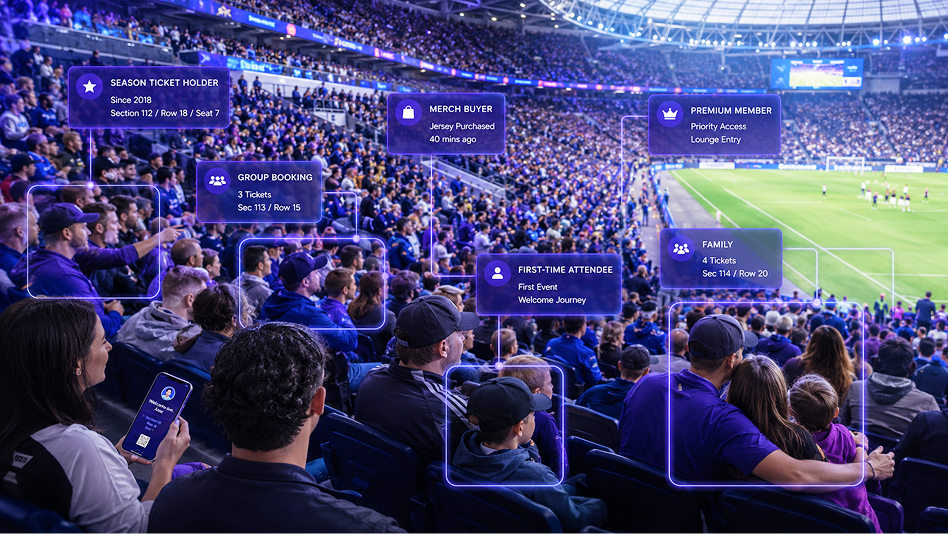
If ticket sales are still the biggest line on your revenue sheet, where’s the growth supposed to come from? That’s the question a lot of sports executives are sitting with heading into 2027. Media rights and sponsorship money is real, but it’s not infinite. And the fans who actually show up to a game are a shrinking share of the audience who cares about your team.
The organizations pulling ahead aren’t waiting on a bigger media deal. They’re finding revenue inside data they already own, technology they already run on gameday, and fan relationships that never required a stadium seat. This is what PEAK’s Revenue Strategy track is built around. It’s exactly what came up when two very different speakers, a ticketing platform CEO and a Microsoft partnerships director, took the stage at PEAK 2026.
What are the biggest sports revenue streams in 2027?
Based on what’s actually working for sports organizations in 2027:
- Ticketing-led commerce: group sales, hospitality, and add-ons sold through the same checkout as the ticket itself
- Media and content: owned channels that build a brand audience, not just a game-day audience
- Data and marketplace opportunities: first-party fan data turned into new commercial products
- Licensing and physical experiences: the venue itself reimagined as a multipurpose, always-booked asset
- AI-powered sponsorship activation: generative tools that make existing sponsor deals produce more content and more data
The numbers behind the shift
$624B
Global sports market by 2027
$48.4B
Global sponsorship spend, +5.0%
$40B+
US youth sports, growing ~10%/yr
81%
Execs who expanded AI use this year
$1,600
Avg. annual fan spend, 80% never attend
The overall sports industry is projected to reach roughly $624 billion by 2027, growing at about 5% a year, per The Business Research Company’s Sports Global Market Report. That growth isn’t evenly spread. According to Two Circles data reported by WARC, global sports sponsorship spend is on pace to hit $48.4 billion this year. That’s a 5.0% jump, the strongest growth the category has seen in a decade. Youth sports is growing even faster. The US market alone already exceeds $40 billion a year and is expanding at nearly 10% annually, per PwC’s 2026 Sports Industry Outlook, which cites Project Play’s family spending survey.
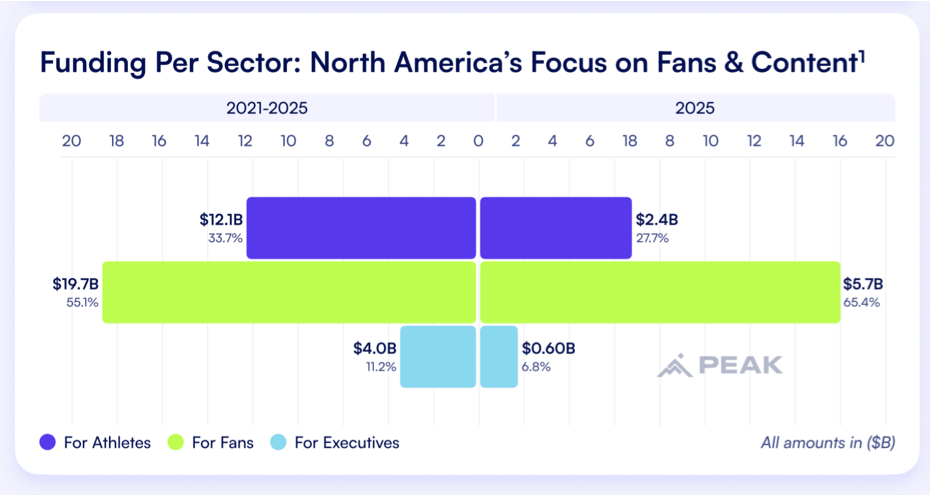
Digital attention is where a lot of this growth is being captured. The average person now spends 2.5 hours a day on short-form video platforms, per Statista. That attention is pulling revenue with it: 81% of sports media executives say they expanded their use of AI in the past year specifically to find new efficiency and revenue, per Stats Perform’s 2026 Fan Engagement, Monetisation and AI Trends survey of 675 executives. The same survey found 70% of respondents say sponsors now demand more digital content than they used to. None of this is happening in a vacuum. Sportstech itself, the tools and platforms making all of it possible, pulled in $8.8 billion in funding in 2025 alone, per the data cited in PEAK’s own 2026 Future of USA SportsTech Report and SportsTechX’s Global SportsTech Ecosystem Report.
Ticket sales aren’t where sports revenue growth is happening
Robert Davari, founder and CEO of the ticketing platform Tixr, opened his PEAK 2026 session with a stat most of the room hadn’t heard framed this way. The average sports fan spends around $1,600 a year on their fandom. Roughly 80% of them never set foot in the stadium. That’s the gap. Most organizations still build their revenue strategy around the 20% who show up.
Davari cited industry research suggesting technology adoption alone could grow sports revenue by about 30%, with the ticketing and event-commerce layer specifically approaching $130 billion. Organizations that lead with fan experience, he said, are growing revenue at roughly 1.7 times the pace of their peers. His closing stat was the one that landed hardest with the room: “90% of sports teams are still on legacy ticketing infrastructure.” In a market this large and this behind, the upside isn’t hypothetical. It’s just unclaimed.
Case study: how one ticketing upgrade changed an MLS team’s revenue mix
Davari walked through what happened when the San Jose Earthquakes moved off a legacy ticketing system and onto Tixr’s platform. The team consolidated group sales, suite sales, and add-on packages, tools that used to live with separate vendors, into a single checkout flow. The results he shared on stage: 60% revenue growth on group ticket sales, and a top ranking in individual ticket growth across all of MLS. 19% of total ticket revenue now comes from non-ticket sources like packages and hospitality that didn’t exist in their old system.
None of that required a new stadium or a new media deal. It required treating the ticket as the entry point to a bigger commerce relationship instead of a single transaction. Davari described a similar move at Houston Dynamo FC. The team built a group-sales page for the Houston Korean community when a visiting Korean star player came to town. It reached an audience a standard season-ticket sales motion would never find on its own.
Ticketing is the anchor, not the whole product
Davari’s core argument was that ticketing touches the fan relationship before almost anything else does. It’s frequently the first digital interaction a fan has with a team, before the app, before the loyalty program, before a single sponsor message reaches them. Once that checkout flow works well, it becomes the natural place to sell everything else: food and beverage, merchandise, parking, and the highest-margin category of all, hospitality packages. Davari said hospitality consistently delivers the biggest single lift to top-line revenue of anything his team tests. A single suite or premium package can be worth many times a standard ticket.
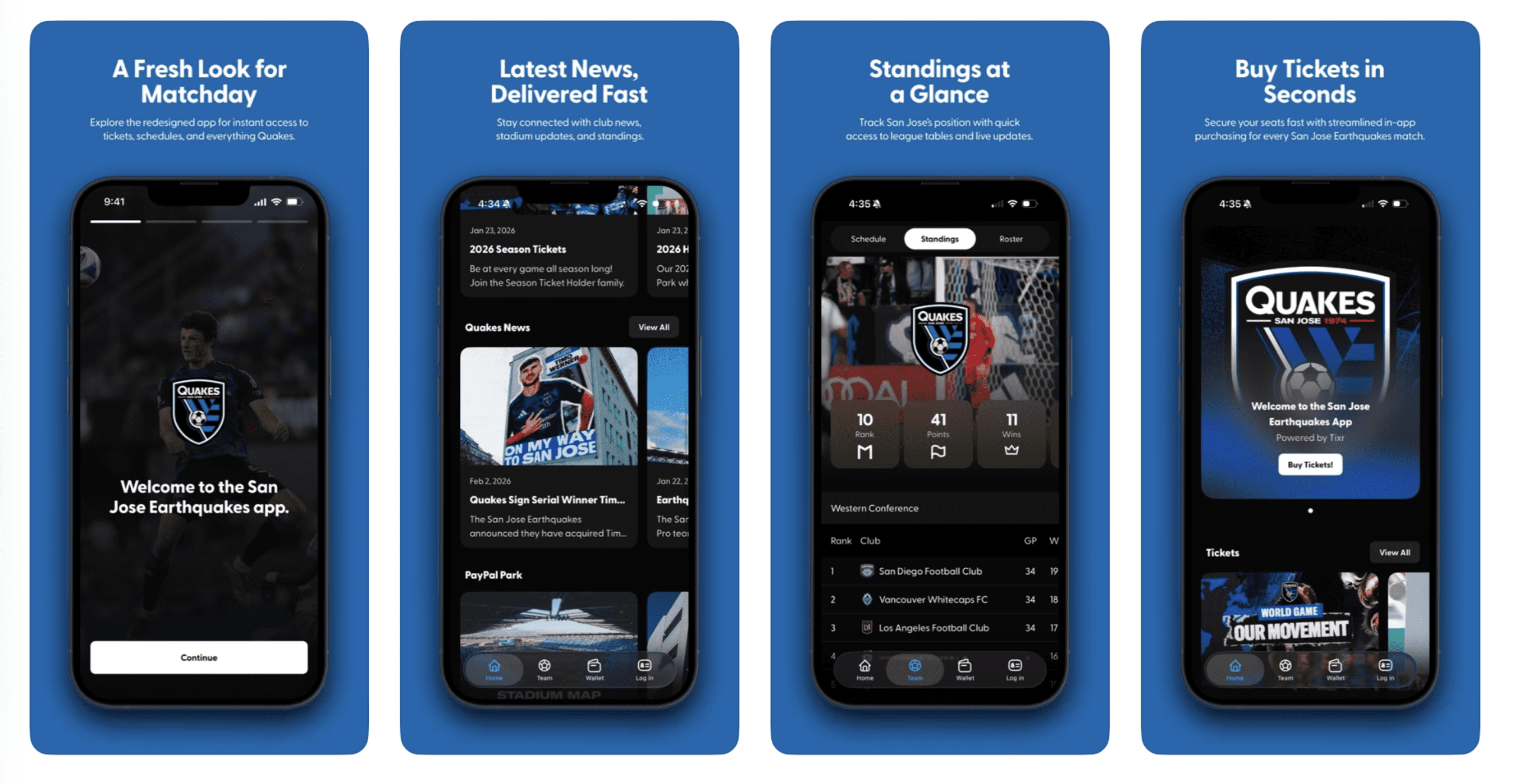
He also pointed to reach as an underrated revenue lever. A modern ticketing platform lets a fan anywhere in the world interface with a team’s brand, not just fans near the stadium. When the San Jose Earthquakes signed German international Timo Werner, Davari expected an immediate uptick in German fans discovering the club. They’d never followed a Major League Soccer team before, simply because the digital storefront was already built to receive them. That’s a fan base a traditional, regional season-ticket strategy was never designed to capture.
The four sports revenue streams every organization already has
Sebastián Lancestremère, WW Strategic Partnerships Director at Microsoft and president of the Global Sports Innovation Center powered by Microsoft, framed the opportunity differently at PEAK 2026. He skipped past technology and opened with a simpler question. What kind of business are you actually running underneath the sports business?
His answer: every team, league, or venue is already operating as some mix of four traditional revenue models. Most organizations just aren’t running all four on purpose.
| Revenue model | What it looks like | Real example |
|---|---|---|
| Media house | Owned content that builds a brand, not just a game-day audience | Red Bull Media House, built around content and lifestyle branding rather than a single sport |
| Data platform | First-party fan data turned into new commercial products and personalization | LaLiga’s fan platform, combining official apps, fantasy games, and streaming into one profile |
| Licensing and physical experience | The venue itself as a multipurpose, always-booked asset | Allegiant Stadium’s convertible field for concerts; Madison Square Garden hosting 380-plus events a year |
| Marketplace | Commercializing assets and data through a partner ecosystem | Sponsorship activations built on generative AI tools, like the Premier League’s Copilot-powered fan Q&A |
None of these four models are new. What’s changed, per Lancestremère, is how cheap and fast it’s become to run all four at once. AI-generated content, automated highlight clips, and Copilot-style tools mean a media rights team, a data team, and a sponsorship team can now pull from the same infrastructure. Each used to require building its own capability from scratch.
The AI layer that makes these revenue streams worth more
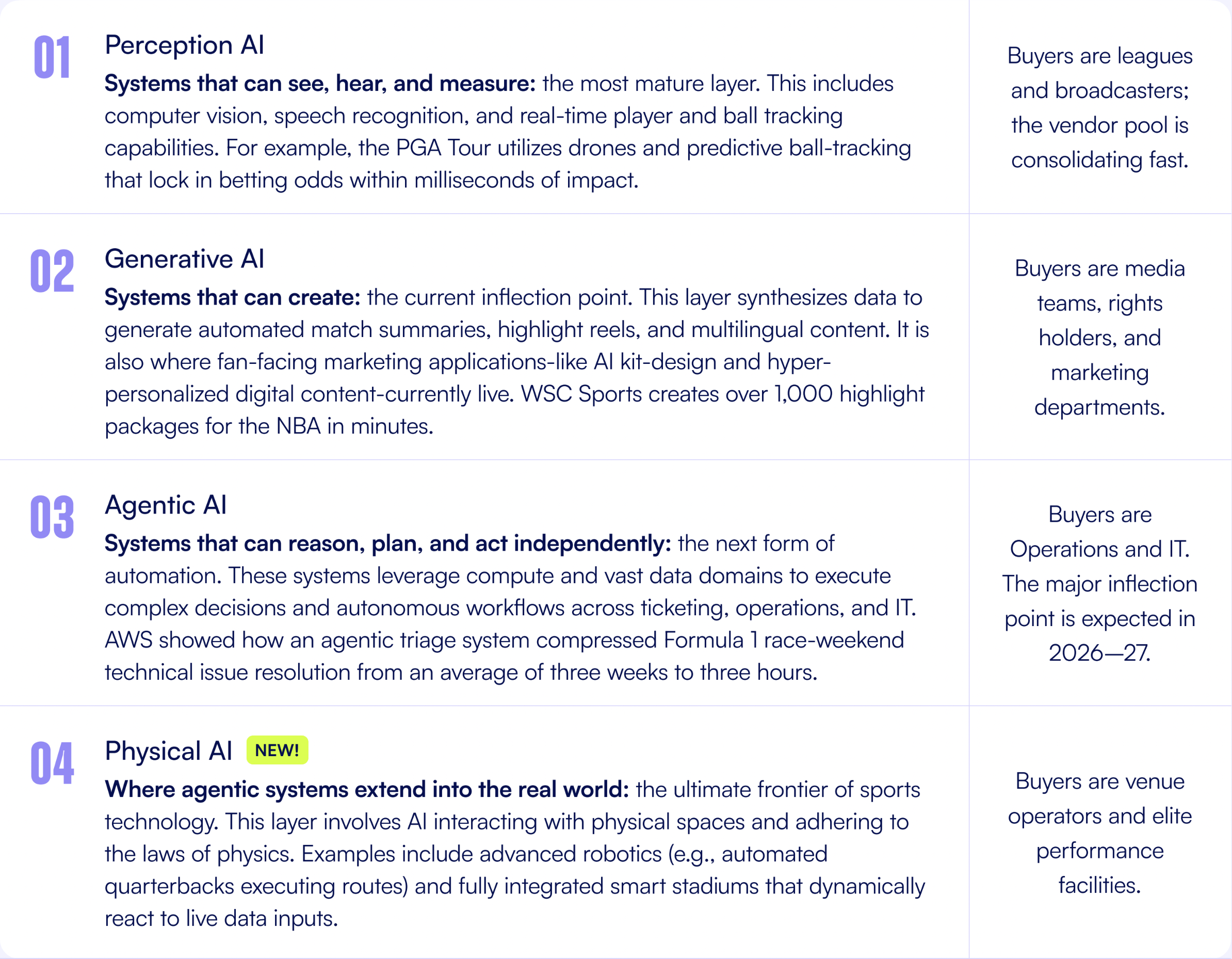
Lancestremère’s Microsoft talk spent real time on why artificial intelligence specifically, not technology in general, is changing the economics of the four revenue models above. It’s part of a broader shift covered in The Future of Sports Technology, where AI shows up across nearly every part of the sports business, not just revenue. One example: during a UEFA Champions League match, a Microsoft partner used computer vision to scan incoming crowds for people not wearing masks or running a high temperature. That work let the venue keep operating safely at full capacity during the pandemic instead of cutting attendance. That kind of infrastructure protects the gate revenue a stadium depends on in the first place.
A second example was built for commercialization rather than safety. Lancestremère showed a real-time win-probability feature built for LaLiga, nicknamed internally the “near impossible goal.” It calculates a shot’s chance of scoring in the moment and displays it during the broadcast replay. He described it as a feature built specifically to be commercialized through broadcasters and sponsors, turning a moment of match data into a sponsorable graphic rather than a one-off stat.
To illustrate how much data these systems already handle, Lancestremère pointed to Microsoft’s collaboration with Mercedes-Benz. It recently extended from smart-factory work into Formula 1 race strategy. A single F1 car carries around 400 sensors, generating roughly 1.1 million data points every second. Sports venues are approaching a similar scale of instrumentation. That’s exactly why Lancestremère argued AI is now a requirement for managing that data volume, not an optional add-on. More headcount or more dashboards alone can’t solve it.
Where the smart money is actually going: AI, data, and the venue itself
Two specific examples from Lancestremère’s talk are worth sitting with if you’re mapping your own 2027 revenue plan. During the pandemic, LaLiga replaced empty stadium noise with a digital crowd audio system. It measured six times higher engagement, since fans weren’t channel-surfing away from the broadcast. That single decision helped protect sponsorship and broadcast renewals during the hardest possible negotiating window. Separately, Microsoft digitized all eight stadiums for the FIFA World Cup in Qatar, with thousands of sensors and cameras feeding a digital twin of each venue. Lancestremère framed that project as an operating-cost and revenue-planning tool, not a fan-experience one: better simulation, lower energy and water use, better decisions about what to build next.
The common thread: the highest-leverage sports revenue work in 2027 isn’t happening in a new sponsorship pitch deck. It’s happening in ticketing systems, data infrastructure, and the physical venue, the parts of the business every organization already owns.
Where to start if you’re not sure which revenue stream to build first
Lancestremère’s advice to the room was deliberately not technical. He told executives to treat this like any other customer problem. Put the fan at the center. Think through what they need before, during, and after the match, then pick two or three specific experiences that would genuinely matter to them. Only after that should a team decide what hardware, software, or facility investment actually supports those experiences.
That ordering matters. It’s the opposite of how a lot of sports organizations approach new revenue today. Most buy a platform or a sensor system first and figure out what to do with it after. Davari’s Tixr case studies followed the same discipline in a narrower lane. The Earthquakes and Houston Dynamo FC results came from asking what would remove friction for a specific fan segment, then building the checkout experience around that answer. Neither came from a generic technology upgrade.
Common sports revenue mistakes to avoid
A few patterns show up repeatedly in how sports organizations approach revenue, and they show up in the data above too.
- Treating ticketing as just ticketing. Davari’s argument was that the checkout is the anchor for a much bigger commerce relationship. Teams that treat it as a single transaction leave the hospitality, group sales, and add-on revenue on the table.
- Ignoring the fans who never show up. Building a revenue strategy around gameday attendance alone means designing for roughly 20% of the fan base. That ignores the 80% who spend money without ever buying a ticket.
- Staying on legacy infrastructure by default. 90% of sports teams are still running on legacy ticketing systems, per Davari. That’s not a niche problem, it’s most of the industry, which means it’s also most of the opportunity.
- Buying technology before deciding what fans actually need. Lancestremère’s advice, cover the fan experience question first, then pick the technology, runs in the opposite direction of how a lot of revenue technology actually gets purchased.
Frequently asked questions
What’s the biggest untapped sports revenue opportunity?
The fans who never attend in person. Robert Davari’s PEAK 2026 data put that figure at roughly 80% of the average sports fan base. They spend real money on the sport without ever buying a ticket. Digital commerce, streaming, and licensing are where that spend gets captured.
How is AI changing sports revenue models?
Mainly by making the existing four revenue models (media, data, licensing, marketplace) cheaper to run simultaneously. Automated highlight generation, Copilot-style fan tools, and AI-driven sponsorship activation let smaller teams run programs that used to require a much bigger content or data team.
Do you need new infrastructure to add a new sports revenue stream?
Not always. The San Jose Earthquakes case study is built entirely on consolidating tools the team already paid for, group sales, suites, add-ons, into one ticketing checkout. The revenue growth came from removing friction, not from building something new.
Where can sports executives learn about revenue strategy in person?
PEAK 2027’s Revenue Strategy track is built specifically around this. Sessions and Solution Huddles connect sports organizations directly with the sportstech companies building these tools. See the full breakdown of sports conferences worth attending in 2027 for how PEAK compares to other events covering this space.
Why this is a Revenue Strategy track conversation, not just a technology one
Every example above sits at the intersection of two things: a real operating problem, and a technology decision that happened to solve it. That’s the exact framing behind PEAK’s Revenue Strategy track, one of six tracks running at PEAK 2027 alongside Business Operations, Smart Venues, Fan Engagement, Media & Broadcasting, and Athlete Performance. Solution Huddles put sports organizations directly in the room with the companies building ticketing, data, and venue technology. Those are the same categories Davari and Lancestremère described on stage.
Discounted tickets on sale now
Build your 2027 revenue strategy at PEAK
Discounted tickets are on sale now, and Sports Organization passes are complimentary by application. March 31–April 2, 2027 · Fontainebleau, Las Vegas.

subscribe to the Peak insider newsletter
Get exclusive insights and connect with top investors in the industry.