Speakers
  Tracks
  Future of SportsTech Report
  Executive Summit
  Startup World Cup 2027
  Official Hotel
  2026 Photos
  Who Attended
  FAQs
FAQs Exclusive Q&A with Mitch Heath: The Strategy Behind Teamworks’ Global Expansion
 Peak Conference
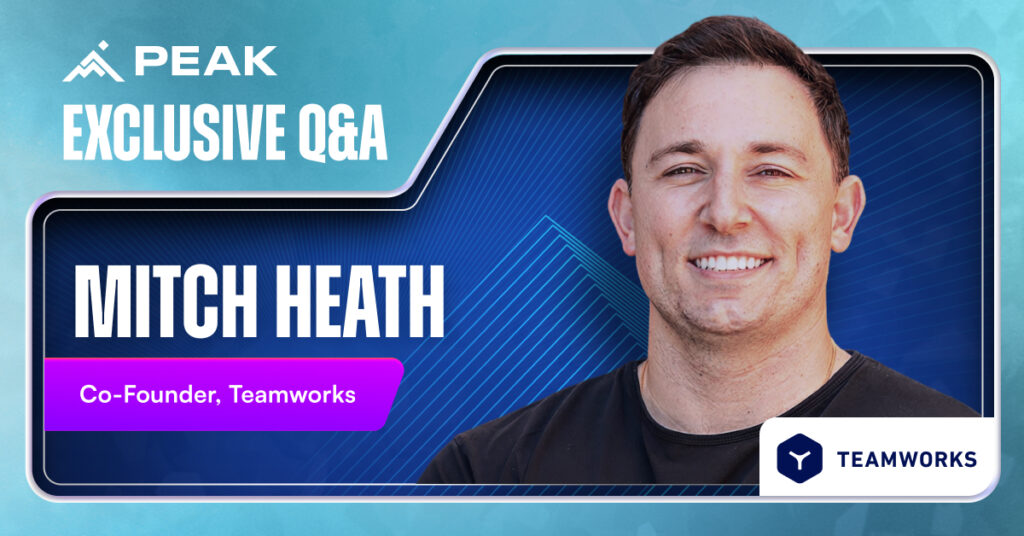
What does it take to scale a SportsTech startup into a billion-dollar platform? We sat down with Mitch Heath, co-founder of Teamworks, for an exclusive Q&A on how he helped transform the company from a college project at Duke into the Operating System for Sports™ – now serving 7,000+ teams worldwide and backed by $400M in funding.
In this conversation, Mitch shares the pivotal moves that fueled Teamworks’ growth, how acquisitions shaped its ecosystem, and why human expertise has become more important than ever as AI adoption accelerates.
Founding Teamworks
What was the original insight or pain point at Duke that sparked the creation of Teamworks – and how similar is today’s product to that initial vision?
From the start, everything we’ve built at Teamworks has been centered around the athlete. The original problem we saw at Duke was that there were a number of highly specialized professionals – coaches, academic advisors, strength coaches, athletic trainers, sports psychologists, etc.- all hired to develop and support Duke athletes, but they were each operating in their own functional silo.
Without a shared system for communication and collaboration, important information slipped through the cracks and the athlete’s experience suffered. Our first product solved that problem by creating a single platform where every staff member could coordinate in service of the athlete and where every athlete could see the most critical information related to their athletic life.
Teamworks added new products over the years and eventually grew the platform into The Operating System for Sports™, with solutions helping teams in every part of their operation – from building the best possible roster, to investing in and developing their athletes, to efficiently managing the day-to-day – but the founding principle hasn’t changed. Every product we build or integrate still has the athlete at the center, ensuring the world’s best athletes are supported by a fully aligned, high-performing team.
Growth Strategy
Teamworks expanded rapidly from college sports into pro leagues and now serves over 7,000 teams globally – what were the pivotal moves or inflection points that unlocked those leaps?
We believed in Teamworks’ earliest days that the technology we were building could serve every elite sports organization in the world, but we understood that we needed to be extremely disciplined and intentional about how we grew and the order and way in which we entered new markets. Our expansion from college football to all college team sports and then to entire collegiate athletic departments required us to plug in deeply with our customers, understand their challenges as well as they did, and understand the nuance of team operations from one sport to the next.
By 2014, as we expanded into the NFL, and then into the MLB, NHL, and NBA soon after, we followed the same playbook to provide common operational best practices while building customizability and configurability that allowed athletes and staff in each sport and at each team to use our technology in a way that fit their needs.
In 2018, we started thinking seriously about international expansion and began laying the groundwork for our entry into the U.K. Australia and Spain followed, and then slowly but surely, we entered top flight leagues across the rest of Europe, the IPL in India and cricket globally, and South American football.
With each of these expansions, focus has been the name of the game. When we enter a new league, region, or sport, we don’t just want to serve a few teams; we want to be strategically positioned and well resourced to serve every athlete in the market.
Download your free copy of the new Future of USA SportsTech Report
Acquisition Strategy
Teamworks has grown both organically and through acquisitions. How do you approach acquisitions in the sports tech space, and what has made them successful?
When we think about growing the Operating System and introducing new products or product categories, we think about the needs of the market as opposed to thinking about acquisition opportunities. We’re constantly listening to customers and working to identify and measure what the biggest unsolved needs are for the organizations we serve. When we uncover a need, we then dive deep into market research and determine if another company is already building great tech to address that particular problem. If not, we’ll often build a solution in house; if so, a partnership or acquisition conversation is a natural next step.
Whether we decide to build or acquire in a given product category, the goal is the same: to bring together the best-in-class sports tech serving athletes and their clubs and leagues. Our vision from our founding was to create a connected ecosystem and to provide a true platform to our customers as opposed to just a menu of products.
Beyond evaluating which companies in the space are building the best tech, the key has been finding real complementarity, both in product capabilities and in culture. One of the advantages in sports tech is that many companies share a common cultural DNA: competitiveness, a drive to win, coachability, and a relentless commitment to being better tomorrow than today.
That shared sports culture makes integration far smoother than you often hear about in other industries. We’ve been fortunate to partner with teams whose values align with ours, which means, from day one, we’re rowing in the same direction and are focused on the same mission.
The Future of Sports Data & AI
How do you see data shaping the future of elite sports organizations, and how should startups position themselves to take advantage of it?
Data is the future. (Or, more accurately, data is the present.) We’ve made huge strides in the last decade as an industry in how we collect and analyze data, but we’re only just starting to see the tip of the iceberg.
I’m most excited about the rapid acceleration in data integration: Historically, data on performance, wellness, recovery, nutrition, finances, operations, scouting, etc. all lived in separate systems, making it difficult to see the full picture of the athlete. Now, those pieces can be integrated, giving us a truly holistic view of the modern elite athlete.
Importantly, with any new technology, and especially in the case of AI, there can be a lot of hype that doesn’t necessarily translate to real impact. At Teamworks, we’ve focused on being extremely intentional and thoughtful in the ways we leverage new technology, building depth in our data models that address industry-specific problems, and we’ve doubled down on recruiting the best of the best data scientists – human expertise has become more important for us as AI adoption accelerates, not less.
For new startups entering the space, it’s easy to get excited about the technical possibilities being unlocked by AI and innovation more broadly, but I don’t think the approach to building a great company changes: Start with the problem, define it clearly, understand its impact, and then assess what technologies are available or can be built (now much faster, easier, and cheaper than before!) to solve the problem.
Want to learn more from Mitch? Grab your ticket to PEAK 2026 and meet him at the global home of SportsTech and Innovation.
Back to top ↑
Subscribe to the PEAKCONF Insider Newsletter
Get exclusive insights and connect with top investors in the industry.